1. Observing Facilities, Opportunities and Responsibilities
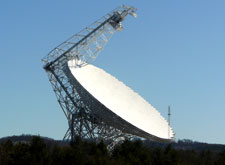
The NRAO operates the Robert C. Byrd Green Bank Telescope (GBT), a 100 m fully-steerable radio telescope at the Green Bank facility. A full complement of radio receivers suitable for both line and continuum work are available from frequencies as low as 290 MHz to as high as 50 GHz, and eventually to 115 GHz. A summary of the technical characteristics of the telescope and receivers appears in the Short Guide to the GBT. The GBT is operated from the Jansky Laboratory in Green Bank. On-line networked computers and display devices are provided at the Jansky Lab Control Room for the astronomer to use for real-time data reduction. Software reduction packages for these computers are provided and maintained by the NRAO staff. New software packages are continuously being developed. Green Bank is connected to the Internet through two, T1 lines.
The NRAO Green Bank facilities are available to all qualified astronomers. The procedure for submitting proposals to the NRAO, and the mechanics of the evaluation and approval of these proposals, are outlined below.
Once scheduled on the telescope, the principal investigator has the responsibility for proper supervision of all aspects of the observing program. The Observatory staff endeavors to provide access to accurate calibration values, tables, and recommended techniques. Confirmation and proper application of data calibration techniques and overall confirmation of data quality is the sole responsibility of the observers. Please budget time for consultations with the staff and for calibration, pointing, and data quality checks during the observing run to ensure that the data will meet your scientific goals. For this reason it is the preference of the NRAO that, except for VLBI observations, the principal investigator or one of his collaborators be in residence during the observations to supervise the program. If the principal investigator cannot be in residence during a significant portion of the observing period, suitable arrangements should be made well in advance of the observations. In general, Observatory staff members cannot be responsible for visitors' programs unless arrangements to the contrary have been made in advance.
All visitors should be aware that radio emissions from common devices such as cell phones, portable computers and other appliances can be detrimental to the on-going observations with the GBT. There are some restrictions on the use of such devices on the NRAO property.
2. Proposals for Observations
The GBT is scheduled on a trimester system (as with the VLA and VLBA), and proposals are accepted at three deadlines during the year:
|
Deadline |
Corresponding Scheduling Period |
|
1 February |
June through September |
|
1 June |
October through January |
|
1 October |
February through May |
The deadlines are typically at 5 p.m. Eastern Time on the day of the deadline, unless the deadline falls on a weekend or holiday, in which case the deadline will be at 5 p.m. on the next business day. Proposals for frequencies above 18 GHz are scheduled during the dry weather periods from October through April each year.
Scientific proposals for use of the Green Bank instruments should be submitted on-line using the Proposal Submission Tool. The proposals should contain a thorough but succinct (1000 word limit) discussion of the scientific justification for the observations being proposed, as well as a discussion of the sources to be observed, the equipment needed, the manner in which the data will be taken, and an estimate of the telescope time needed to carry out the scientific program. A source list containing source identifications and coordinates should be included. For extensive list (>50 objects), specific criteria defining the observing sample may be substituted. Special needs, instrumentation or software, should also be noted explicitly. The Scientific Justification, Technical Justification, and Source List may be prepared as separate files and attached using the Proposal Submission Tool. The Scientific and Technical justifications may be prepared in ASCII text, Postscript, or PDF formats. Figures may be attached as JPEG, GIF, PS, or EPS files.
Once received, the proposals are typically sent to five referees -- established scientists with broad backgrounds and considerable experience in radio astronomy but unaffiliated with the NRAO -- who consider each of the proposals individually and advise the Scheduling Committee as to whether the scientific merit of the proposal warrants allocation of telescope time and, if so, with what restrictions. Using the referees' grades and remarks as a guide, the proposals are considered by the Scheduling Committee, which is composed of scientists from the NRAO and user community. Based on the decisions of the the Committee, the observations are either scheduled or retired. In all cases, the proposers will receive a copy of the referees' and Scheduling Committee comments and disposition. The telescope scheduler will notify successful observers of the dates of their observing time. Proposers who were not granted time are welcomed to revise and resubmit their proposals at a later deadline.
3. Logistics of Observing at Green Bank
A. The Green Bank Organization
The following individuals should be contacted when questions arise in their areas of responsibility:
Richard Prestage (x2222) Assistant Director, NRAO / Site Director Green Bank, in charge of the site and scientific operation of the GBT.
Carl Bignell (x2165), GBT Scheduler, in charge of proposal scheduling, coordinates observer facilities.
Ron Maddalena (x2207), Staff scientist in charge of astronomical support.
Mike Holstine (x2231) GB Business Manager; responsible for Green Bank business management and administrative services.
Becky Warner (x2227) Administrative Asst., arranges transportation, residence hall housing and cafeteria services.
In addition, more general questions or comments pertaining to Observatory-wide activities (scheduling procedures, scientific or instrumentation priorities, inter-site relations) or specific criticisms of, or suggestions for, the Green Bank operation may be addressed either to the NRAO Director, Dr. Fred Lo, or to the NRAO Deputy Director, Dr. Phil Jewell, both of whom are located at the Charlottesville, Virginia Headquarters offices.
B. Travel to Green Bank
TRAVEL ARRANGEMENTS: In principle, observers may use a number of area airports for their travel to Green Bank. These include Washington Dulles, Pittsburgh, Charlottesville, Roanoke (Va.), Charleston (WVa), or Clarksburg (WVa). In addition, limited AMTRACK train service is available to Charlottesville and White Sulphur Springs, WVa. Rental cars are available at most of the airports. The Observatory can also send a driver for pickup at any of these airports or stations. It is most convenient if visitors can make travel plans and connections to Charlottesville whenever possible. Transportation will then be available between the NRAO Charlottesville Headquarters office and Green Bank. A GSA vehicle will usually be available at the NRAO Edgemont Road Office Building at Charlottesville for you to drive to Green Bank. Plans to use the GSA vehicle should be arranged with Becky Warner in Green Bank (x2227). If you do not have your own transportation or cannot make connections through Charlottesville, alternate arrangements may be made with Becky Warner.
SITE TRANSPORTATION: GBT observations are conducted from the Control Room in the Jansky Lab, located on the main business campus of the Green Bank site and just across the road from the Residence Hall and Cafeteria. In general, observers will have no need for automobile transportation on site. Should the need arise, however, diesel-powered automobiles are available for the astronomers' on-site use while in Green Bank. These vehicles may be obtained from Becky Warner (Room 103, Jansky Addition) during working hours, or by advance arrangement with her if outside working hours. Please return keys promptly when you have finished with a vehicle. Bicycles are also available from Becky Warner.
TRAVEL REIMBURSEMENT FOR OBSERVING RUNS AND DATA REDUCTION SESSIONS: For each observing program scheduled on an NRAO telescope, reimbursement may be requested for one of the U.S. investigators to travel to the NRAO to observe, and for one of the U.S. investigators to travel to the NRAO to reduce data. Reimbursement may be requested for a second U.S. investigator to either observe or reduce data provided the second investigator is a student, graduate or undergraduate. In addition, NRAO will, in some cases, provide travel support to the Observatory for research on archival data. The reimbursement will be for the actual cost of economy airfare, up to a limit of $1000. Costs of lodging in NRAO facilities can be waived on request in advance and on approval of the relevant site director (Richard Prestage for Green Bank). No reimbursement will be made for ground transportation or meals. (A complete statement of the policy with instructions for requesting reimbursement can be found at http://www.nrao.edu/administration/directors_office.)
To be eligible for this reimbursement, the astronomers should obtain a travel authorization voucher from Shirley Curry (Room 108, Jansky Addition) which, when approved by Richard Prestage (Room 107, Jansky Addition.), can be sent with the appropriate ticket stubs to the fiscal division in Green Bank for reimbursement. (Original ticket receipts must be submitted with request for reimbursement form). The request for reimbursement must be submitted within 30 days of the completion of travel.
Other questions regarding the travel policy may be addressed to Mike Holstine (x2231, Room 102, Jansky Addition.).
C. Green Bank Housing
RESIDENCE HALL: The NRAO operates a residence hall where astronomers may stay while observing or reducing data after completion of their observations. Single rooms (2 beds) are available for $49.50 (+ tax) a day single occupancy or $38.50 (+ tax) per day per person double occupancy. Students attending a degree conferring college or university and coming to Green Bank to use the telescope will pay single room rate $42.00 (+ tax) or $26.50 (+ tax) per day per person double occupancy. In addition, there are four one-bedroom apartments with equipped kitchens which the astronomer may occupy at $74.30 (+ tax) per day. Cribs, high chairs, and fold-up beds are also available. As noted above, costs of lodging in NRAO facilities can be waived on request in advance and on approval of the Site Director, Richard Prestage.
SINGLE-FAMILY HOUSES: The NRAO maintains a few 3- and 4-bedroom furnished houses on the observatory property which are available from time to time for astronomers wishing to come to Green Bank with their families for extended periods.
RESERVATIONS: Housing reservations may be made by contacting Becky Warner (304-456-2227).
KEY PICK-UP: Keys are located on the room assignments board in the Residence Hall Lobby.
REGISTRATION: Please fill out the registration card accompanying your key and return it to the cafeteria cashier.
BILLING: Payment for lodging expenses should be made, if possible, prior to departure to the secretary in Room 103 of the Jansky Laboratory between the hours of 8:00 a.m. and 4:30 p.m., Monday through Friday.
CHECKOUT: 11:00 a.m. Please drop key in the key return box in the lobby of the Residence Hall.
BED AND BATH LINEN: The Residence Hall rooms will be made-up prior to check-in and will be provided with adequate towels, wash cloths, soap, etc. For residents staying a week or more, rooms will be cleaned and linens changed once per week.
PERSONAL LAUNDRY: A washer and dryer are available for Residence Hall guests at the north end of the basement. Laundry detergent is provided.
LOUNGE: The lounge is intended for use of Residence Hall guests only.
EXERCISE AND RECREATION ROOMS: An exercise room with a number of exercise devices, including treadmills, stationary bicycles, stair-steppers, weight machine, and free weights are available for use by Observatory visitors. The Exercise Room is located in the basement of the Residence Hall. The punch key code for the room is available from Becky Warner. In addition, a recreation room with a pool table and air hockey table is also located in the basement. SITE ACCESS: Observatory visitors are welcome to tour the site by foot or by bicycle, which are available in racks in front of the Residence Hall and Jansky Lab. Please stay on the paved roads and do not go underneath any of the telescopes. Please return to the main campus area at the east end of the site by dark.
D. Cafeteria Meal Hours
The site cafeteria, located on the south end of the Residence Hall, is open for business at the following times:
| Day | Breakfast | Lunch | Dinner |
| Monday - Friday | 7:30 - 9:30 a.m. | 12:00 - 1:00 p.m. | 5:00 - 6:30 p.m. |
| Saturday | Self-serve in the Lounge | 12:00 - 1:00 p.m. | 5:00 - 6:00 p.m. |
| Sunday | Self-serve in the Lounge | 12:00 - 1:00 p.m. | 5:00 - 6:00 p.m. |
DOORS CLOSED 6:30 p.m.
Cafeteria closed all other hours!
Notes:
(1) A self-service coffee room is available in the basement of the Jansky Lab (turn left at the base of the stairs) and in the Operations Canteen on the second floor of the Jansky Lab Addition, near the Control Room..
(2) Prior to 11:00 a.m. Saturday, Residence Hall guests may obtain a light breakfast of such items as coffee, milk, tea, juices, sweet rolls, cereal, and toast in the Residence Hall Lounge Kitchenette.
(3) Residence Hall guests may order special sandwiches for consumption during periods when the cafeteria is closed. These sandwiches will be identified for the guest and placed in the refrigerator in the lounge. A special fast-heat oven is available in the lounge to heat the sandwiches.
E. Telephone
Local Calls: dial 9 and the 7-digit number.
Long Distance: dial 9 and 7- or 10-digit number.
It is not necessary to dial a 1. The site operator (Dial 0) located in Room 112 of the Jansky Addition (Mon.-Fri. 8:00 a.m. to 4:30 p.m.) Can provide assistance and directories.
Business Calls: Observers and other official visitors to the site may use the telephone facilities for legitimate calls in connection with their business, within reason. Personal calls should be paid by the visitor (see below).
Personal Long Distance Calls: All commercial long distance calls should be paid by the visitor. There are two ways to do this: (1) use a personal telephone credit card (such as AT&T, MCI, SPRINT, etc.); (2) use a pre-paid telephone calling card. Pre-paid cards are available for purchase at the Reception Desk at the Jansky Lab. Please do not make direct-dialed long distance calls for personal business, if at all possible.
F. Library
An up-to-date collection of major astronomical journals is available in the Jansky Laboratory. In addition, a set of the National Geographic Society and Palomar Observatory Sky Survey prints is available for visitors and staff use. Alesia Wayne is the librarian and can help if needed on Monday, Tuesday, Thursday and Friday (3:45 p.m. - 5:45 p.m.)
G. Office Space/Supplies
Work space is available in Jansky Lab Control Room and on the first floor of the Jansky Lab Addition (just below the control room) in the Observer's Periphery, Room 105 and the Observer's Work Room, Room 135. Miscellaneous supplies are available in the cabinets across from the entry doors in the original wing of the Lab. Sue Shears (Room 108, original wing) can help with special supply needs.
H. Green Bank Data Tapes
The Observatory will archive and save all data from the GBT, with the possible exception of very large data volumes or data from user-supplied backends. These archives will be stored in a safe location and will be available for backup copies should they be needed at some point.
Observers should arrange for their own export tapes from their observing run. A variety of formats are available. Export tape copying will be coordinated by the Telescope Operations group. The Observatory will provide one export tape per observing run, free of charge to observers. Observers will be billed for any additional tapes they may require. This tape policy is subject to change.
CD-Rom copies of the AIPS++ data reduction system are also available, free of charge.
J. Data Proprietary Period: Following NRAO policy, observers have proprietary rights to the data for 18 months following the final observing session of their program. At the conclusion of this proprietary period, the data will be available from the NRAO Archive for reduction by others, upon their request. Those wishing to use data from the archive are encouraged to contact the original observers to ensure that any special issues concerning the data are understood. While this contact is encouraged, it is not required, and observers should be aware that the data will be in the public domain and subject to open use after 18 months.
4. Observing
INSTRUMENTATION/SOFTWARE: Visitors who require special hardware or software configurations for their projects must make their requests at the time the proposal is submitted. Requests for non-standard facilities or capabilities will be considered in light of feasibility, priorities, project schedules, etc. Observers will be notified of the outcome when the results from the Scheduling Committee are distributed. Last minute requests for non-standard capabilities cannot be granted, in general.
PROPRIETY: Each observer is scheduled on the telescope with the understanding that he or she is to pursue only the program described in his observing request. Since we have many observers from various institutions working on related programs, we require that any observer wishing to change his program, or to exchange time with other observers, do so only with the consent of the Site Director and Telescope Scheduler.
OBSERVER COMMENTS: In an effort to improve our facilities and service, we request that observers completing their observations provide us with a brief summary of their observations, and remarks about any difficulties they encountered. An on-line form for Observer Comments is available at http://www.gb.nrao.edu/php/obscom/obscomments.php. These remarks are usually distributed to a number of staff and managers, and are usually not kept confidential. Confidential remarks should be made to the Site Director or NRAO Director.
NEWSLETTER: The Observatory publishes a newsletter containing useful information about developments and the current status of the Observatory, including systems at Green Bank, Charlottesville, Tucson, and Socorro. Requests to receive the newsletter should be sent to newsletter@nrao.edu or to Dr. Barry Turner in Charlottesville. If you have an interesting scientific result to contribute to the Newsletter, please contact Dr. Turner.
USER MANUALS: Several user manuals are available which describe in detail the telescope control, data acquisition and data reduction programs that are implemented in Green Bank. These are available on-line include
GBT Users Manual (presently in first draft form)
OBSERVER ASSISTANCE: Each observing program will be assigned a "friend" from among the staff scientists. You will be notified of who your friend is prior to your observing run by the Telescope Scheduler, Carl Bignell. The friend will serve as your contact person both before, during, and after your run for all scientific and technical issues. The friend can generally be available at the start of your run to assist in initial setup, and can be available as required during the course of the run. The friend (or in his/her absence, the Telescope Operator) will coordinate assistance from others on the technical or scientific staff whose assistance or expertise may be needed.
INFORMATION SHARING: The staff of NRAO-Green Bank is interested in the results of the research they support. Feedback to them assures that their efforts are consonant with your goals. They especially appreciate informal colloquia. If you wish to make a presentation please contact Jay Lockman (304-456-2302) or Toney Minter (304-456-2275).
5. Publication of Results
ACKNOWLEDGMENT: Whenever a significant portion of research was done, or observational material taken, at the NRAO, we request that the author include a footnote in the text where the Observatory is mentioned:The National Radio Astronomy Observatory is a facility of the National Science Foundation operated under cooperative agreement by Associated Universities, Inc.
PAGE CHARGE REIMBURSEMENT: When requested, for papers reporting original observations made with any NRAO instrument(s), NRAO will pay 100% of the page charges for all authors at a U.S. scientific or educational institution. This is an increase from our current support of 50%. In addition, NRAO will, in some cases, provide page charge support for papers based on the Observatory's archival data. The new level of support will apply to all requests for page charges submitted after 1 April 2001. (A complete statement of the policy and requirements, with instructions for requesting page charge support, can be found at http://www.nrao.edu/library/page_charges.shtml.)
All NRAO scientific and engineering staff members, as well as visitors who have used any NRAO instruments, are expected to notify the Charlottesville library about all in press papers. This includes both papers for which you expect to request page charge support and those going to meeting proceedings or journals where page charges are not required.