MUSTANG-2
As of Summer 2021 this web page is no longer being updated. For information about MUSTANG-2 proposals, observations and data analysis please refer to: this web page
MUSTANG-2 is a 223-feedhorn bolometer camera which was commissioned on the GBT in spring 2016, and is being offered for observations on a shared risk basis, in collaboration with the instrument team, in the 2018A GBO proposal call. Several features distinguish it from its predecessor, MUSTANG:
- A new, microstrip-coupled detector design yields higher sensitivity and less susceptibility to environmental microphonics.
- Detectors are feedhorn coupled, with the sum of two linear polarizations measured by a single TES per feed.
- The instantaneous field of view is 4 arcminutes (vs 42 arcseconds for MUSTANG)
- The receiver design incorporates a tilted refrigerator and receiver rotator, resulting in much lower dependence of cooling performance on telescope elevation.
- The detector readout is the first astronomical use of microwave resonators to multiplex TES bolometers.
Some basic performance information is as follows:
- The demonstrated sensitivity of MUSTANG-2 on the GBT in good
weather on the GBT is 73 micro-Kelvin main beam temperature (RMS, Rayleigh-Jeans) in
one hour of integration. The 73 micro-K sensitivity corresponds to 56
micro-Jy/bm RMS in terms of flux density (for SZ proposers please
note: 56 microJy/bm is roughly a 2.0e-5 RMS in Compton y for the GBT
beam, including near sidelobes). This is with a 2'.5 radius "daisy"
scan pattern which produces a centrally weighted sensitivity profile
over a ~6' FWHM region; see figure below for the radial profile of
sensitivity seen in such maps.
Smaller scan patterns with lower noise
in the center are possible, although significantly smaller scan
patterns may be more susceptible to subtle imaging systematics and are
not recommended except in special cases such as targeted point source
photometry. For significantly larger areas faster scanning can be
used which will reduce the noise by up to 35% ( note: by a 35%
reduction in noise, it is meant that the expected noise be multiplied
by 0.65). Proposals must explicitly state a target map RMS in
order to be evaluated for scheduling.
A more detailed presentation of the sensitivity, with a view to
SZE in Galaxy Clusters, is given in the following
memo: Executive summary: Observing with MUSTANG-2
ERRATUM: please ignore the 42 micro-Kelvin number in this figure, 73 micro-Kelvin (RJ) is the correct number. The Jy/bm number is still valid.
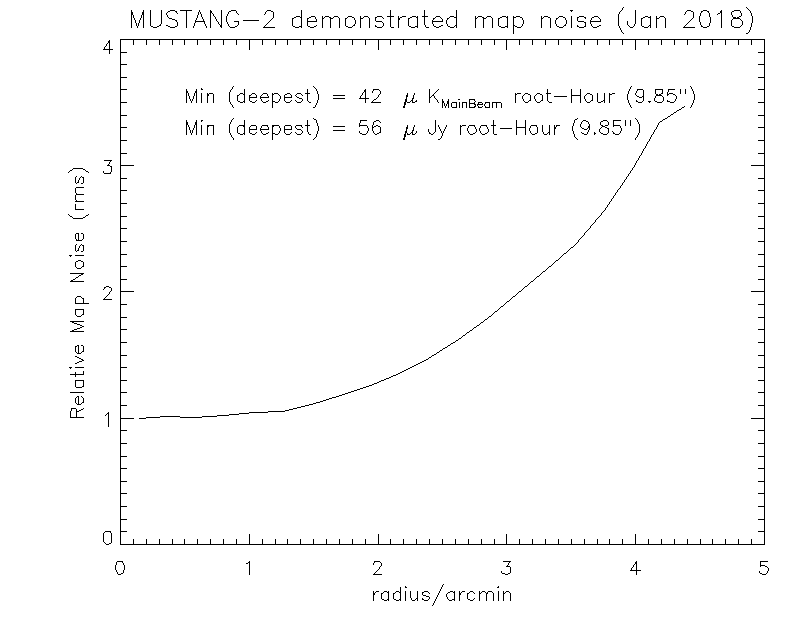
- This sensitivity assumes an effective smoothing of 9".85 FWHM. If heavier smoothing is acceptable the sensitivity is better by a factor of (FWHM/9.85 arcsec).
- Extended emission on scales up to 5' should be imaged with reasonable fidelity, but faint emission more extended than this may be difficult to detect. Bright emission (20 mJy/beam or more) can be reconstructed over scales of many arcminutes. The angular resolution of MUSTANG on the GBT is tyipcally 9" (FWHM) and the instantaneous field of view is a 4' diameter circle.
- Allowing for weather and calibration and observing overheads, observers should conservatively allow an observing efficiency of 50% (i.e., assume equal times integrating on source, and for calibrating and general overheads - so 100% overheads relative to observing time). A minimum setup and calibration time of 1 hour is generally required for each observing session.
- Daytime observing at 90 GHz is currently not advised. The changing solar illumination gives rise to thermal distortions in the telescope structure which make calibrating 90 GHz data extremely difficult. Useful 3mm observations are currently only possible between 3h after sunset and sunrise.
Please contact Brian Mason (bmason - nrao - edu) with further questions.
The Status of Future GBT Open-Skies Observing
In order to cope with an evolving funding landscape the GBT is in the process of moving to a model which relies upon a larger fraction of private and collaborative ("pay-to-play") partnerships. It is expected that a significant fraction of GBT time, depending on the future level of NSF funding, will remain open under something like the current proposable, open-skies arrangement; however the mix of observing capabilities that is available under this arrangement is TBD. If you are interested in forming or contributing to such a partnership to ensure continued access to MUSTANG-2 on the GBT, please contact the director of the Green Bank Observatory, Karen O'Neil.
MUSTANG & MUSTANG-2 Publications
- Galaxy Cluster Pressure Profiles, as Determined by Sunyaev-Zeldovich Effect Observations with MUSTANG and Bolocam. I. Joint Analysis Technique (C. Romero et al. 2015, ApJ 807, 121)
- Measurements of the Sunyaev-Zel'dovich Effect in MACS J0647.7+7015 and MACS J1206.2-0847 at High Angular Resolution with MUSTANG (A. Young et al. 2015, ApJ 809, 185)
- MUSTANG-2: A Large Focal-Plane Array for the 100m Green Bank Telescopes (S.Dicker et al., 2014 JLTP 176, 808)
- Evidence for large grains in the star-forming filament OMC 2/3 (S. Schnee et al., MNRAS 44, 2303S)
- 90 GHz Continuum Observations of Messier 66 (B. Nikolic & R. Bolton, 2011 MNRAS 425, 1275)
- A Multi-wavelength Study of the Sunyaev-Zel'dovich Effect in the Triple-Merger Cluster MACS J0717.5+3745 with MUSTANG and Bolocam (T. Mroczkowski et al., 2012 ApJ 761, 47)
- Related EVLA press release
- Confirming the Primarily Smooth Structure of the Vega Debris Disk at Millimeter Wavelengths (A.M. Hughes et al., 2012 ApJ 750, 82)
- Discovery of the correspondence between intra-cluster radio emission and a high pressure region detected through the Sunyaev-Zel'dovich effec (Ferrari et al. 2011, A&A 534, L12)
- MUSTANG 3.3 Millimeter
Continuum Observations of Class 0 Protostars (Shirley et al. 2011, AJ 141, 39)
- MUSTANG High Angular Resolution Sunyaev-Zel'dovich Effect Imaging of Sub-Structure in Four Galaxy Clusters (Korngut et al. 2011, ApJ 734, 10)
- High-frequency Radio Spectral Energy Distributions and Polarization Fractions of Sources in an Atacama Cosmology Telescope Survey Field (Sajina et al. 2011, ApJ 732, 45)
- Implications of a High Angular Resolution Image of the Sunyaev-Zel'dovich Effect in RXJ1347-1145 (Mason et al. 2010, ApJ 716, 739)
- The Radio-2 mm Spectral Index of the Crab Nebula" (Arendt et al. 2011, ApJ 734, 54)
- 90GHz and 150GHz observations of the Orion M42 region. A sub-millimeter to radio analysis (Dicker et al., 2009 ApJ 705 226)
- Observations of M87 and Hydra A at 90 GHz (Cotton et al., 2009 ApJ 701 1872)
- MUSTANG: 90 GHz Science with the Green Bank Telescope (Dicker et al., Presented at the SPIE conference on astronomical instrumentation in 2008; "Millimeter and Submillimeter Detectors and Instrumentation for Astronomy IV.", Proc. SPIE, Volume 7020, pg 702005, (2008))
- A 90-GHz bolometer array for the Green Bank Telescope (Dicker et al. in Millimeter and Submillimeter Detectors and Instrumentation for Astronomy III. Edited by Zmuidzinas, Jonas; Holland, Wayne S.; Withington, Stafford; Duncan, William D.. Proceedings of the SPIE, Volume 6275, pp. 62751B (2006))
We request that publications resulting from MUSTANG observations on
the GBT include the following acknowledgement: "The authors would
like to thank the MUSTANG instrument team from the University of
Pennsylvania, NRAO, Cardiff University, NASA-GSFC, and NIST for their
efforts on the instrument and software that have made this work
possible. ". Additionally, we request that you
cite Dicker
et al. (2008) in the paper text.
NRAO offers page charge support if you do a few simple things.
Links
- University of Pennsylvania MUSTANG Web Page
- NRAO Proposal Submission Tool
- Resources for GBT Astronomers
- February 2009 NRAO e-news article about MUSTANG.
- February 2009 and May 2009 NRAO e-news articles about GBT surface improvements.
- Information about 90 GHz weather conditions in Green Bank
- Related EVLA press release
NEWS
MUSTANG-2 on GBT to Commence Science Observing (Dec, 2016)
MUSTANG-2 has been installed on the GBT with upgraded readout multiplexers and 211 detectors working. Observing on shared risk science proposals in collaboration with the instrument team have begun.
MUSTANG-2 First Light on GBT (May, 2016)
The full MUSTANG-2 camera achieved first light on the GBT in May, 2016! It will return to the GBT in fall 2016 for shared-risk science through the 2017-A Green Bank Observatory proposal call.
MUSTANG-2 green-lighted for full production (July, 2015)
The NSF ATI program has funded our proposal to fully populated the MUSTANG-2 focal plane with 215 dual polarization detectors. The completed MUSTANG-2 receiver is expected to arrive at the GBT for commissioning & early science observations early in 2016.
MUSTANG-1.5 completes successful engineering run on the GBT (May, 2015)
MUSTANG-1.5 was successfully integrated with the GBT and first light observations of a variety of sources obtained. This run allowed the team to shake out final integration issues with the telescope and software systems, and constituted the first astronomical use of MKID-style microwave resonators to read out TES detectors.
MUSTANG-1.5 Arrives at the GBT (December 2, 2014)
MUSTANG-1.5 arrived in Green Bank and is preparing for first light on the GBT later this month!
MUSTANG-2 is Under Construction!
MUSTANG-1.5 is currently being integrated and tested in the lab at U.Penn., with first light on the GBT scheduled for winter 2014.
MUSTANG-2 Detectors delivered to U.Penn!
In June 2014 72 packaged detectors were delivered to U.Penn for testing and characterization.
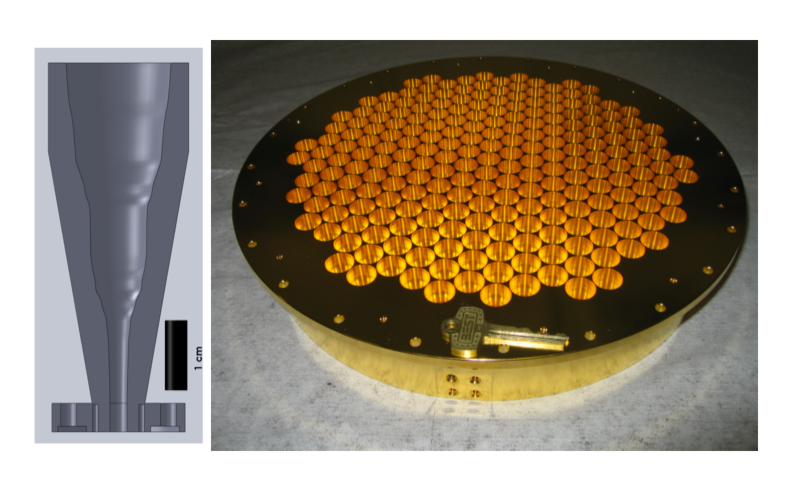
Left: Cutaway view of tapered feed design; Right: the final MUSTANG-2 feed horn array as fabricated (223 feeds). The feed array weighs 8kg and has been successfully cooled to 300 mK in the MUSTANG-2 cryostat.
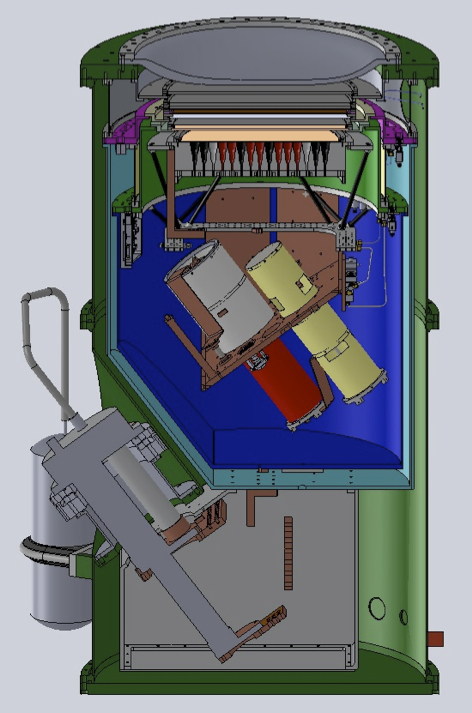
Cutaway showing the design of the MUSTANG-1.5 receiver

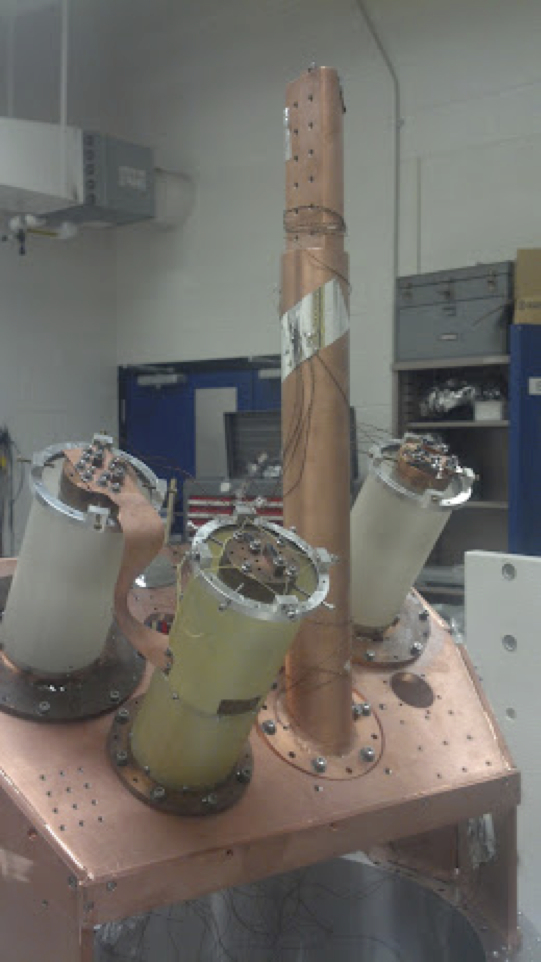
Pictures of the receiver in the lab at U.Penn.
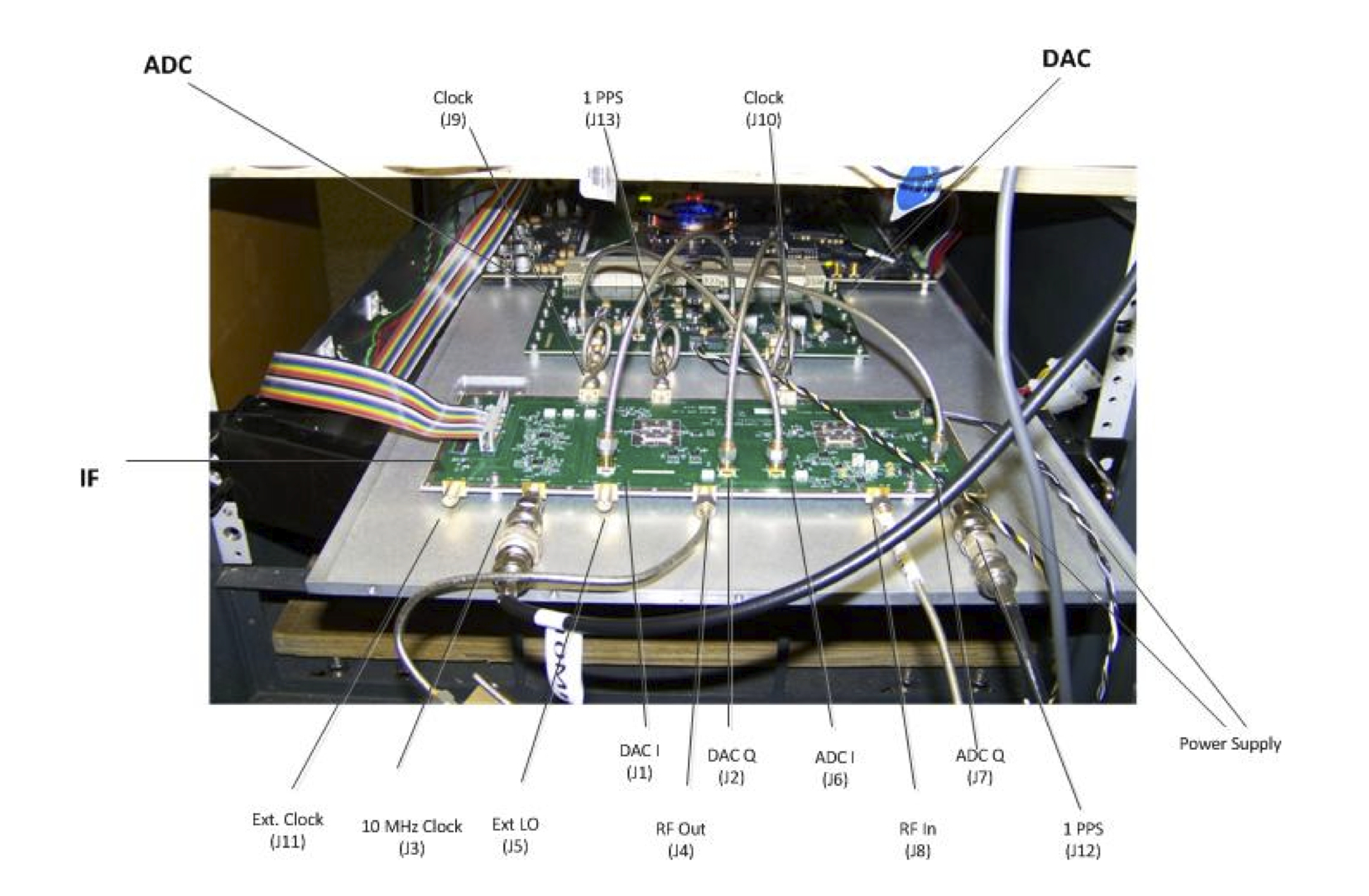
One ROACH board with its custom daughter cards for the microwave resonator readout.
MUSTANG retired at the end of 2013
MUSTANG-- the original 90 GHz, 64 pixel GBT bolometer camera-- was retired at the end of calendar year 2013 in anticipation of the arrival of its successor, MUSTANG-1.5 MUSTANG proposals were accepted from June 2009 through Feburary 2012.
New GBT Surface Improvements (Sept. 2009)
A concerted campaign of phase coherent holography measurements and actuator repairs has resulted in further, remarkable improvements in the GBT surface: the current Ruze-equivalent surface RMS is estimated to be better than 275 microns rms! This means that MUSTANG should be at least 50% more sensitive than it was for Spring 2009 observing. The following image shows a sequence of surface maps made over the course of the year.

(courtesy T.Hunter & F.Scwab, NRAO)
GBT Surface Improvements (July 2009)
The campaign of traditional, phase-coherent holography led by Todd Hunter & Fred Schwab is paying off, having already yielded a factor of two improvement in the GBT 90 GHz aperture efficiency with more improvements on the way. More information can be found in the February and May NRAO e-news.
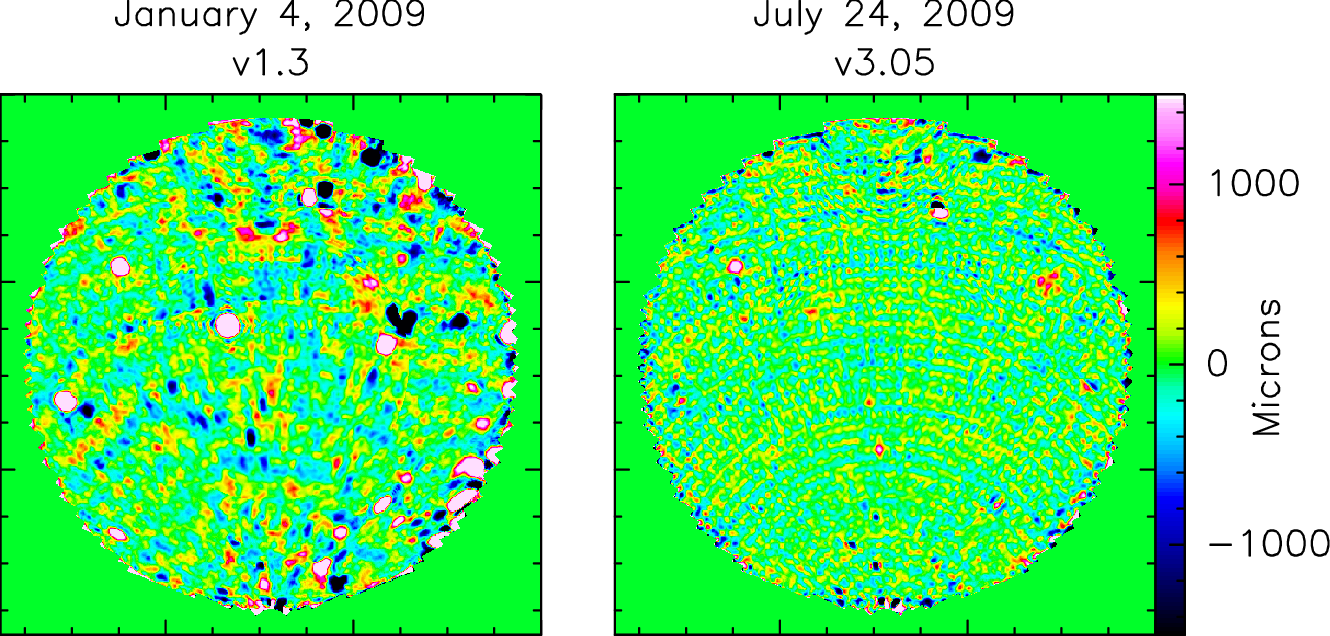
Map of GBT surface irregularities before (left) and after (right) corrections based on a series of holographic surface maps. The version numbers refer to which set of surface corrections were in place at the time the map was made, with higher numbers (e.g., v3.05) indicating more recent, better maps. (Image courtesy of Todd Hunter & Fred Schwab, NRAO)
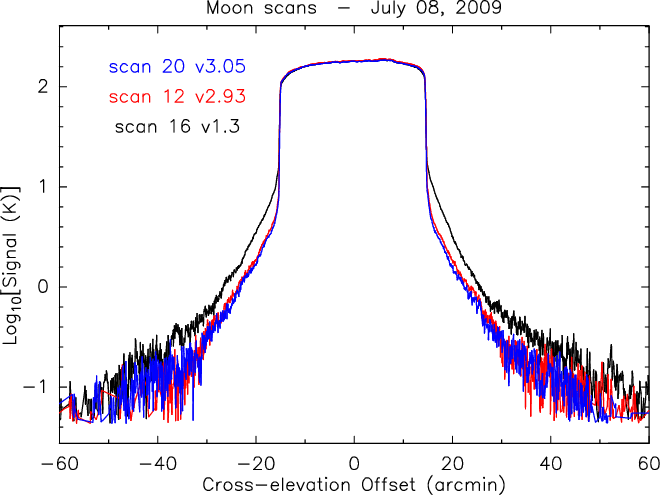
Scans across the moon at 46 GHz with the GBT with three different sets of surface corrections in place on the telescope, showing the far sidelobe response. The more recent telescope surfaces yield substantially lower sidelobe levels, as expected. (Image courtesy of Todd Hunter & Fred Schwab, NRAO)
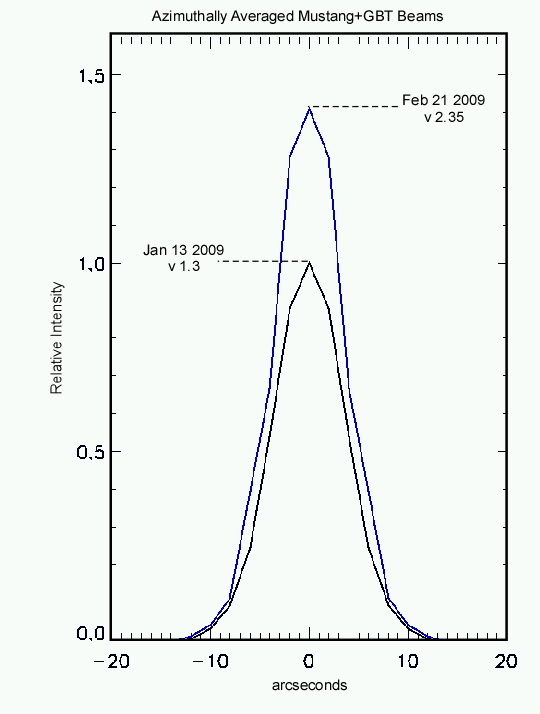
Scan through a calibrator source with MUSTANG showing the initial, 10% efficient surface response (v1.3), and the improvement that results from an early set of holographic surface corrections (v2.35). On this scale the July 24 2009 map (v3.05) is expected to give a peak intensity of 2. (Analysis by Phil Korngut, U.Penn)
Real-time GBT Surface Updates
Using "out-of-focus" or phase-retrieval holography techniques, it is possible to make real time measurements of the medium to large scale aberrations in the GBT surface by analyzing in-focus and out-of-focus beam maps of bright calibrator sources. Acquiring the data, analyzing it, and applying the resulting corrections to the telescope surface requires less than 15 minutes with MUSTANG, and the process is essentially completely automated (requiring the user only to push a button to accept & send the solution).
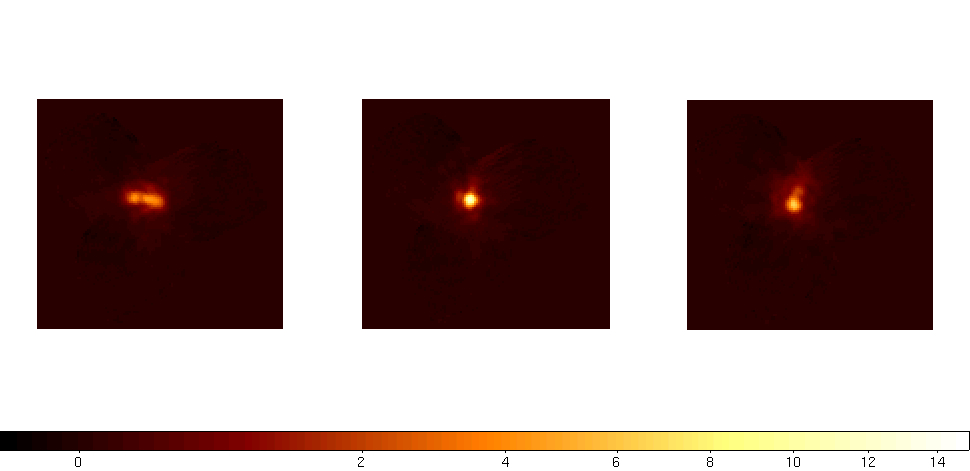
In focus (center) and two out of focus (left, right) maps of a bright point source.
 |
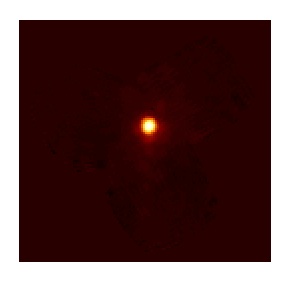 |
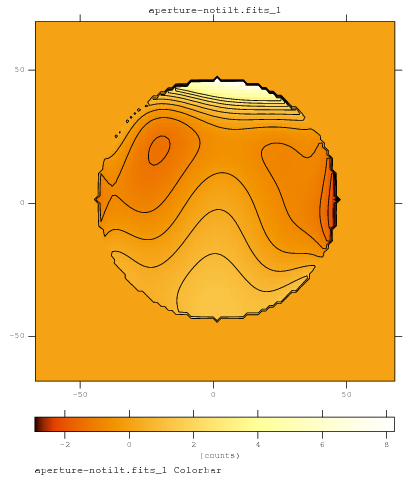
Left: GBT phase error map derived from the beam map data above. Color scale is in radians; note that since MUSTANG only illuminates the central r=45m, the phase at the outer edge of the dish is unconstrained and not important observationally. Right: The beam that results from applying the aperture phase corrections to the telescope (on a slightly burned in scale, common to all four beam map plots). Near-in sidelobe levels are lower and the peak foward gain is typically increased by 20-30%.
Early Science Images
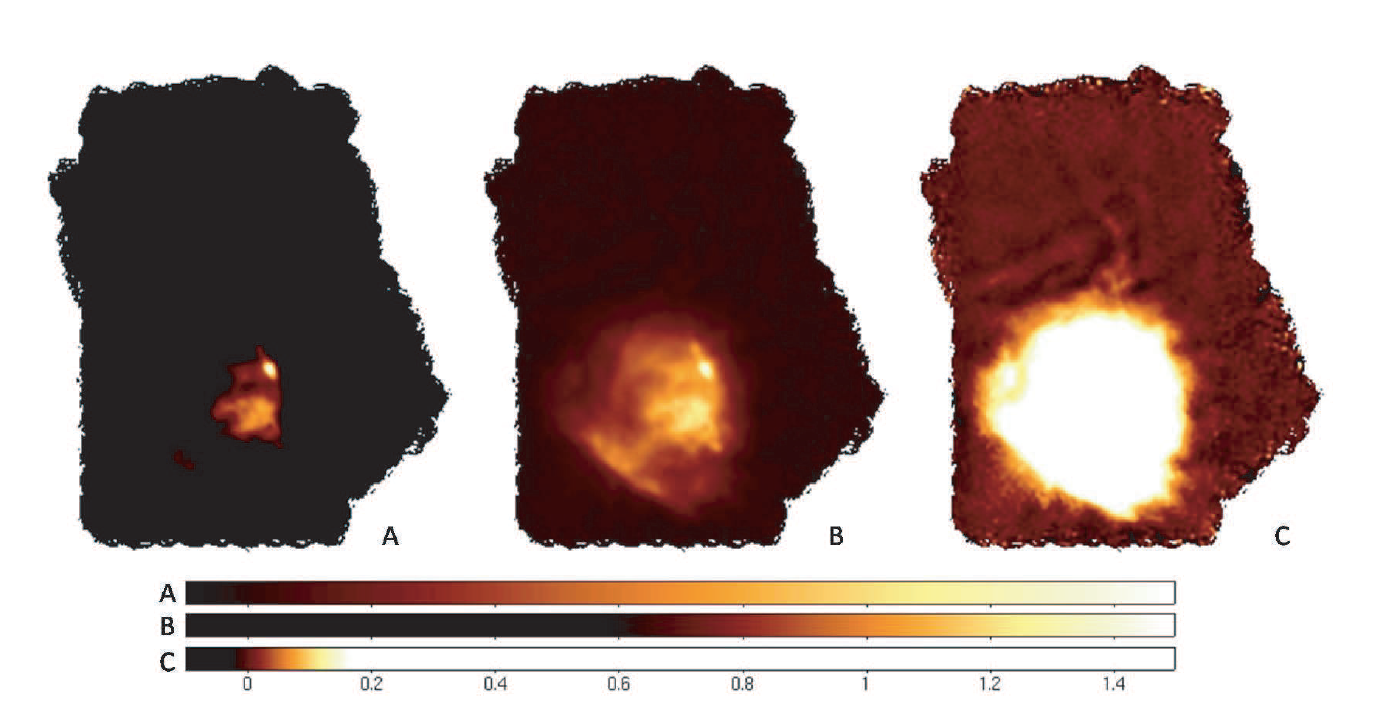
MUSTANG+GBT 90 GHz map of Orion on 3 color scales emphasizing the
dynamic range and sensitivity to extended structure that has been
achieved. These maps resulted from early science observations in
Spring 2008; the area covered is approximately 5'x10'.
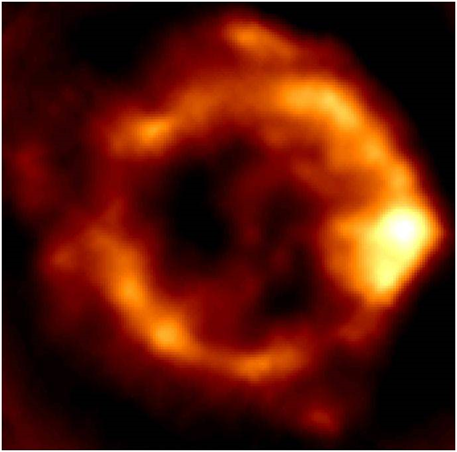
MUSTANG+GBT map of Cas A collected during commissioning, January 2009.
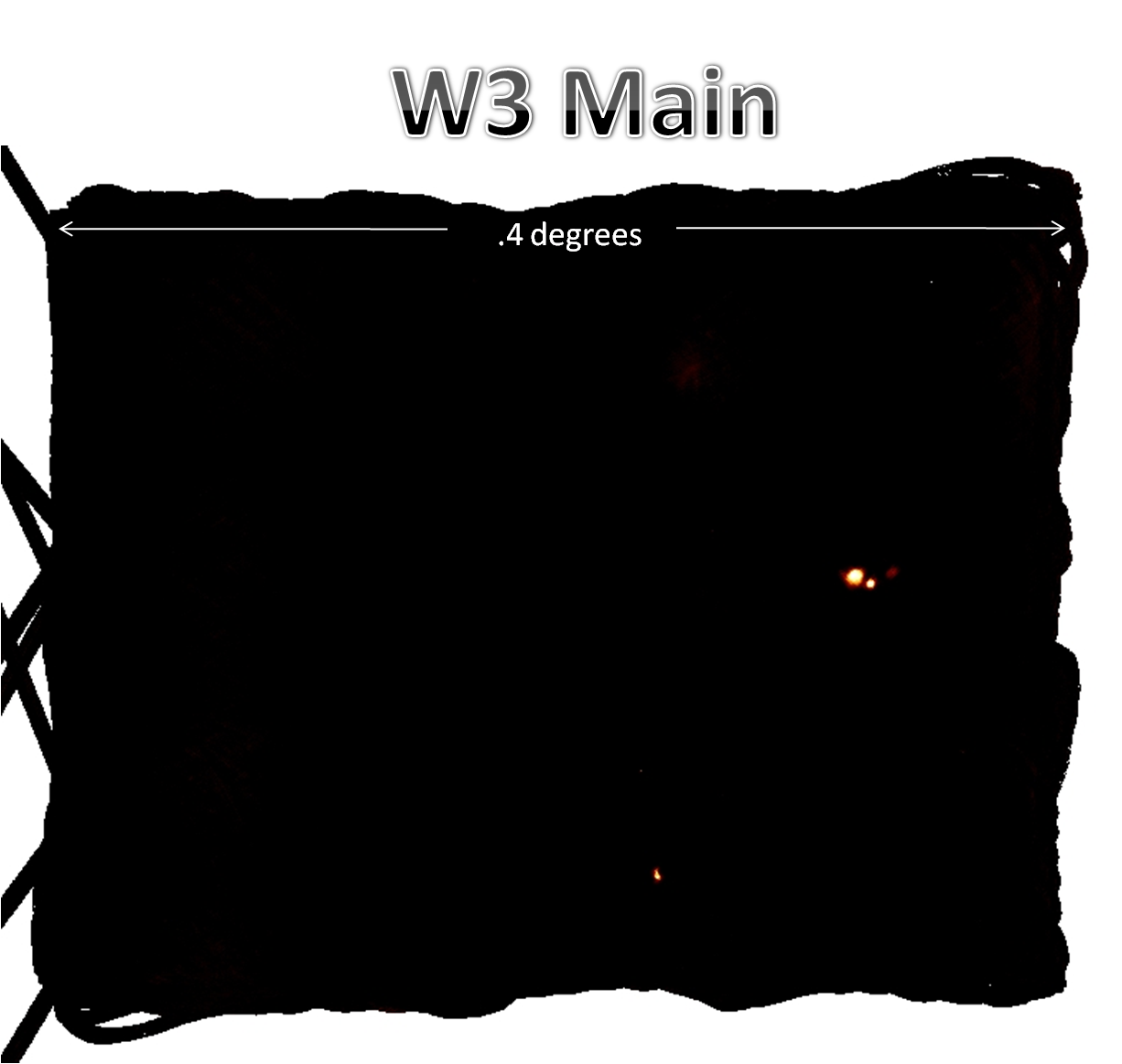
MUSTANG+GBT large-area map of the W3 region (0.4 deg x 0.3 deg). This map required 45 minutes to collect and was a test of MUSTANG's large-area mapping capability. Due to the high slew speeds involve it is possible to suppress instrument and atmospheric "1/f" noise to a greater extent than is possible when mapping smaller fields, resulting in a 25% improvement in sensitivity.