
where the constant is determined (through experiment) by the filter used.
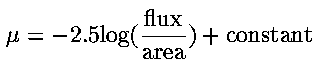
or

(D is the diameter in arcsec,  is in mag/arcsec
 )
)
Who Cares?
What is surface brightness?
where the constant is determined (through experiment) by the filter used.
or
(D is the diameter in arcsec, is in mag/arcsec
)
 "
"
LSB galaxies have a range of types as large as the Hubble sequence, though they are dominated by late-type (often dwarf) galaxies (McGaugh, et.al 1995).
Bulge component of LSB disk galaxies are faint or totally undetectable, except in a significant subset (i.e. Malin I & II) with very bright bulges (McGaugh, et.al. 1995).
The low sky contrast, 'clumpiness', of LSB galaxies makes classification in the Hubble scheme difficult.
A few examples.
Most LSB galaxies are rich in H I (Schombert, et.al. 1992), though their surface density of H I is at or below the threshold criteria for star formation (Bothun, et.al., 1993, Kennicutt, 1989).
Blue colors, lack of metal eliminate the idea that LSB galaxies are faded remnents of HSB galaxies. (i.e. McGaugh 1994)
H II regions indicate the same IMF as HSB galaxies (McGaugh & Bothun, 1994, Schombert, et.al. 1992).
LSB galaxies appear to follow the same large scale (>5 Mpc) structure as HSB galaxies (Bothun, et.al. 1993).
On small scales (<2 Mpc), though, LSB galaxies avoid high density environments (Bothun, et.al. 1993).
LSB galaxies usually (but not always) lack companion galaxies and thus the tidal interactions necessary for star formation (Bothun et.al., 1993).
form stars at a constant rate after a late collapse(McGaugh & Bothun, 1994), or
have a SFR which is gradually increasing with time (McGaugh & Bothun, 1994), or
have a sporadic SFR (the best bet so far) (Block, et.al. 1995).
