A HST WFPC2 Survey in the Virgo Cluster
Instrumentation, Data Reduction, and Galaxy Identification
- Used the HST WFPC2 to image part of the Virgo cluster
- Consists of four cameras - 3 wide field cameras and one planetary camera
- Wide field cameras have 0.096"/pixel
- Planetary camera has 0.0046"/pixel
- 80" x 80" fields were taken around VCC 1582, V2L8, VCC 1149, and Malin 1
- Fields were imaged through both the F814W and F300W filters
- Sky flat were taken of the bright earth and calibrated against an internal flat field system
- Intrinsic dark rate is < 0.01 electron/pixel/second
- Data reduction done using the STSDAS pipeline calibration system
- Four images were taken of each field through each filter and median combined
- Zeropoints taken from the PHOTOFLAM value given for each image
- Zeropoints used for the STMAG system
- Galaxy identification was done using both a `bye-eye' search and FOCAS
- By-eye seach method same as used for Texas data
- FOCAS searched for galaxies with r
 4 pixels,
2
4 pixels,
2
- FOCAS could not identify the amorphous galaxies (many of the galaxies found)
- By-eye method identified all galaxies found by FOCAS plus many more
- Galaxy analysis done using the GASP and IRAF software, as before
Surface Brightness and Galaxy Type
- 215 potential galaxies were found
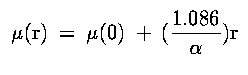
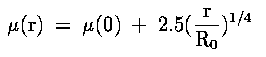
- Two different sb profiles were fit against the data
- An exponential profile:
- And an r
 -type profile:
- Central surface brightness ranges from 13.6 mag arcsec
 through 25.5 mag arcsec
- Galaxies then classified by sb profile:
- A - Galaxies well fit by an r-type profile
- Considered to be E/S0 galaxies
- 10 galaxies fit this catagory, 9 of which appear to be E/S0
- B - Galaxies well fit by an exponential profile
- Considered to be Sa-Sc type galaxies
- 30% of the galaxies
- 1/3 of the galaxies in this category have definate bulges and are prob type Sa/Sb
- 2/3 have purely exponential profiles
- C - Galaxies which were not well fit by either profile, interacting galaxies
- Galaxies classified as Sd, Irr, pec, and merging (IPM)
- 45% of the galaxies found
- One subgroup has very bumpy sb profiles, similar to many LSB galaxy profiles
- 9% of the galaxies in this group have king profiles
- At least 22 of these galaxies appear to be interacting
- And roughly 16% of the galaxies were to faint to have any sb profile reliably fit
HST Faint Galaxy Morphology
- Medium and deep HST surveys have high percentage of Irr/pec/merging (IPM) galaxies
- Previously beleived local galaxies had a much lower percentage of IPM galaxies
- High number of IPM galaxies has led to `rapid evolution' models
- Need to explain the apparent excess of IPM galaxies at z > 0.5
- Could be due to rapid merging around z=1
- Could be a mechanism to cause rapid fading around z=0.5
- No other local survey has been done using the WFPC2
- WFPC2 has 10x better resolution than typical terrestrial telescopes
(15x better than McDonald 30"!)
- Reducing the resolution by even 4x makes a huge difference:
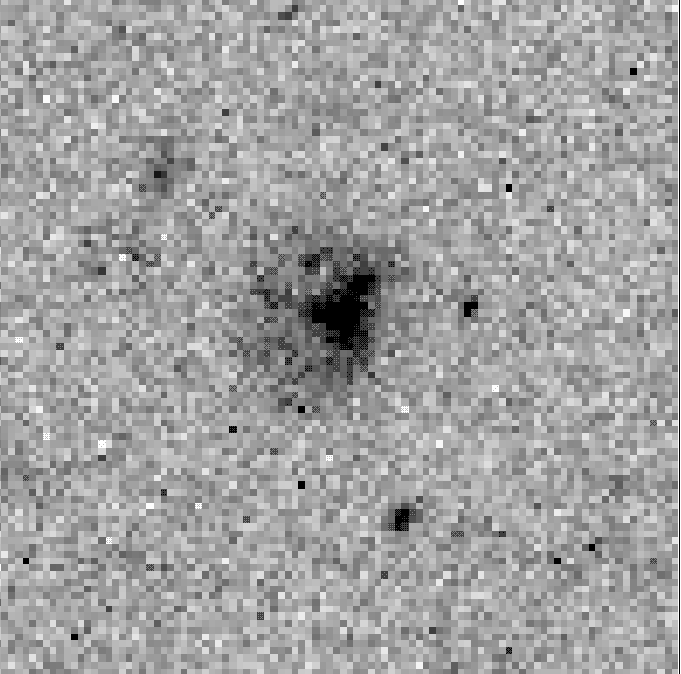
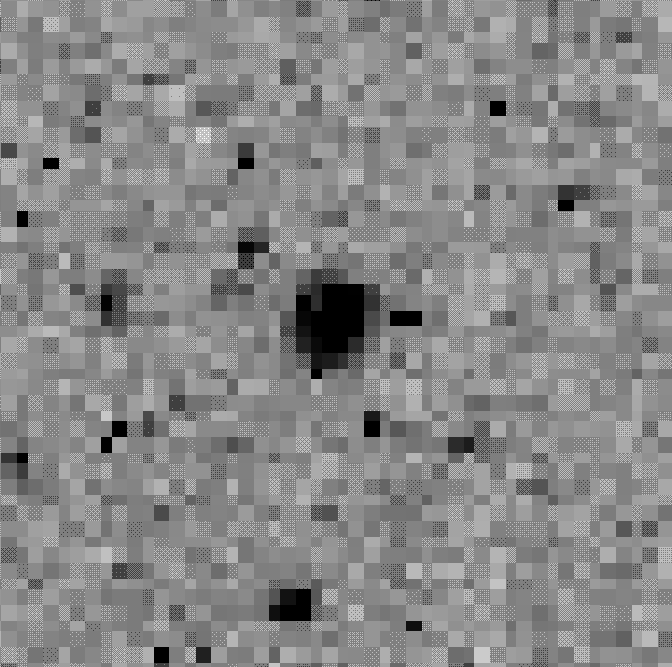
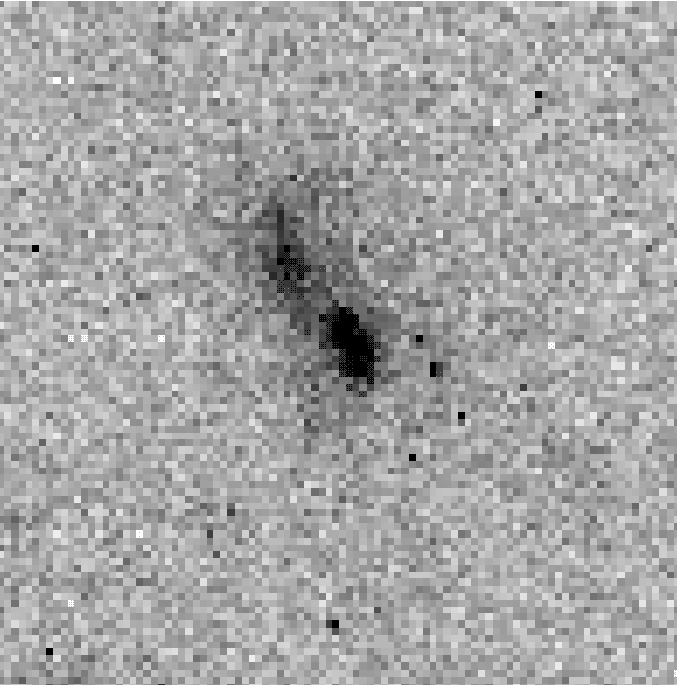
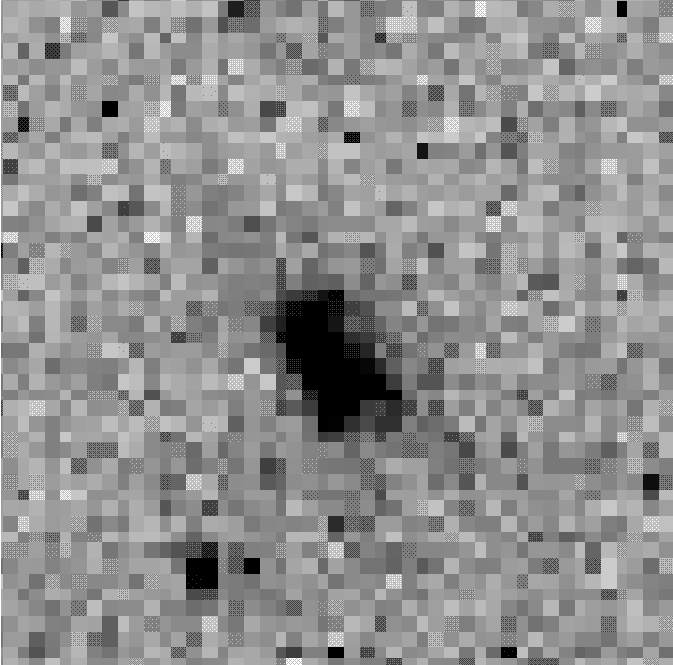
- It is likely the `excess' of galaxies at z > 0.5 is due to the higher resolution of the WFPC2
- Galaxies in this survey could be the local counterparts to the IPM galaxies at high redshift
Note we haven't gotten the redshifts of these galaxies
- Large number of galaxies found show increased use of the HST WFPC2 would significantly increase the
total number of known galaxies, as well as provide a detailed view of galactic structure