Radio flashes reveal the origins of the universe’s most energetic particles.
Here we summarize previous research and development in the use of clusters of radio telescopes to detect flashes.
By measuring the coinsidence times of these flashes, we can reveal
the origin and nature of cosmic rays. Previous research has used gamma ray detectors, optical florescence
detectors and low frequency radio flash telescope arrays.
We plan development of a global cosmic ray detector collaboration, where students
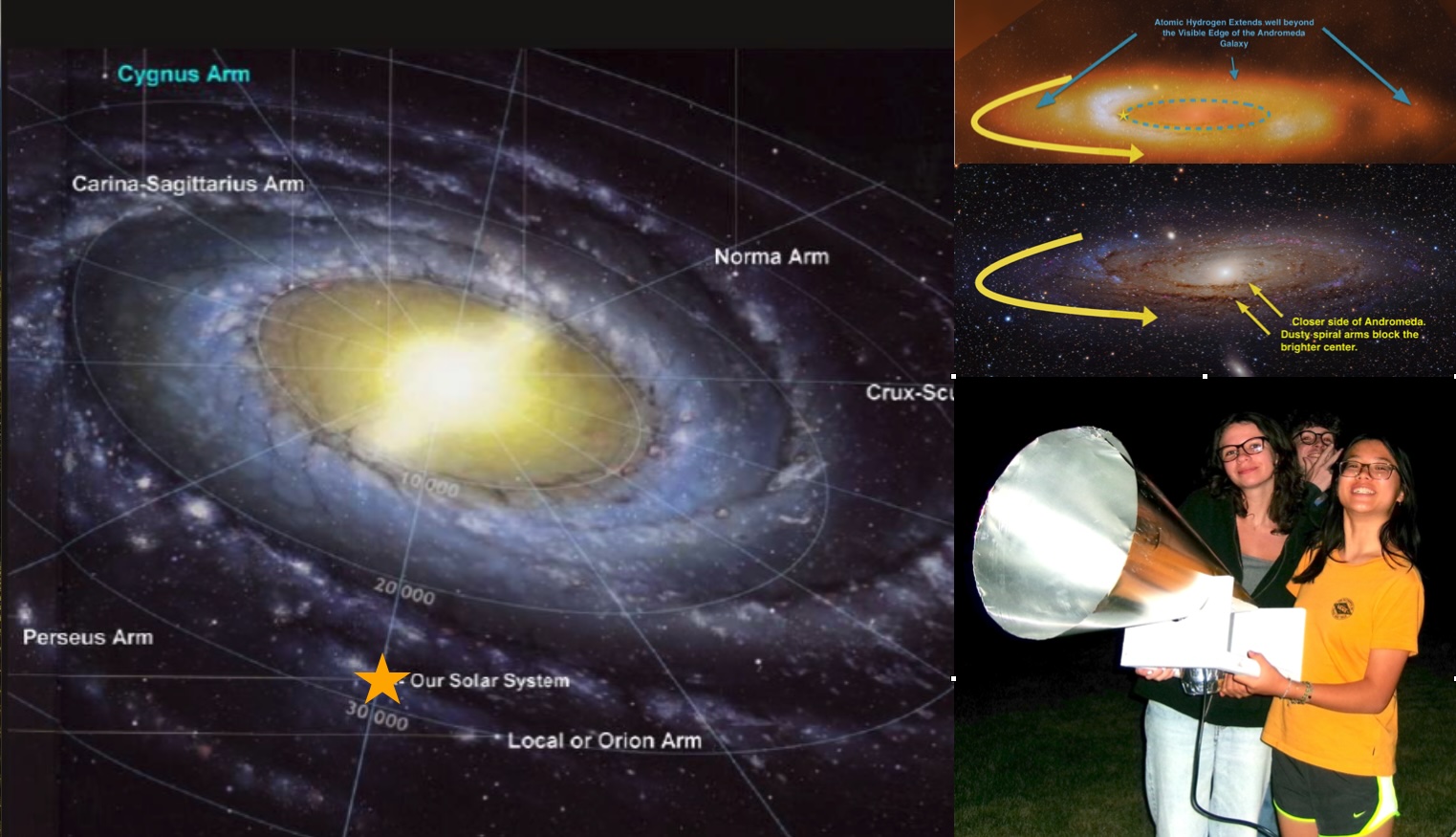
build and operate their own horn radio telescopes, operating at 1421.5 MHz, to look for patterns in
cosmic ray arrival times. Each student would make valuable and unique contributions to this research effort.
This web site includes our previous measurements detections of cosmic rays, based on observations in
2025 The observations are organized into Month and Day directories where the month directory
summarized the total number of events found. For example see April 2025.
The day directories show the voltage signals measured when matching
simultaneous events detected by at least 3 horn radio telescopes.
For example on April 30, 2025 9 events, or event groups, were detected. The data
streams are plotted and the measurements are available in sub-directories.
(Alternatively see April 30, 2025).
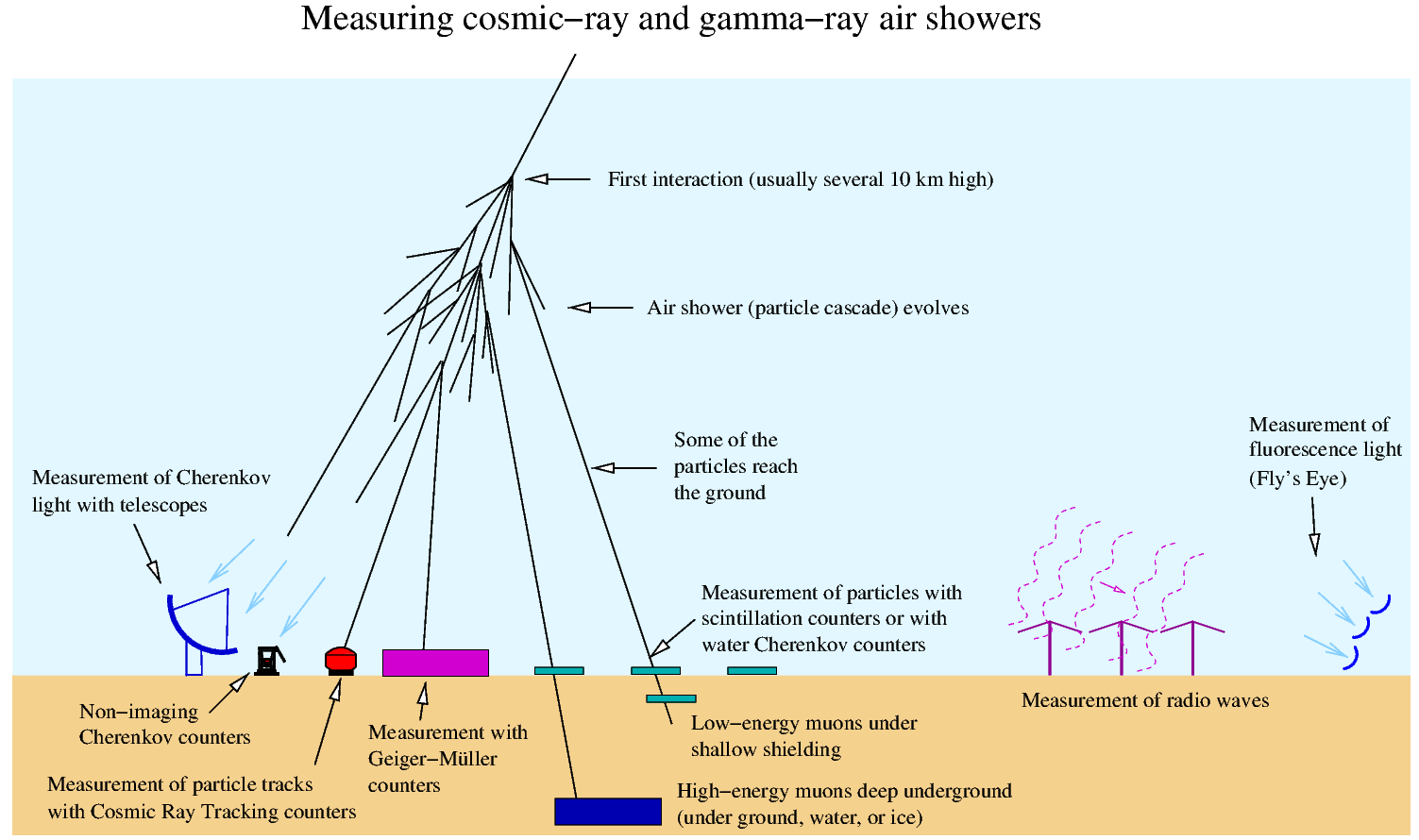
When a high‑energy cosmic ray strikes the atmosphere, it produces a cascade of
secondary particles known as an extensive air shower. Because the particles hit the
earths atmopshere at a height of 10 km, a telescope monitors a large volume, so is highly sensitive
to ultra high energy cosmic rays.
As electrons and positrons in the shower are deflected by Earth’s magnetic field,
they emit a coherent radio pulse detectable on the ground.
A number of research efforts are on-going, detecting these short duration radio flashes.
Notable is the French
CODALEMA project,
operating in the frequency ranges 30-80 and 120-200 MHz. Their detection approach is to have each telescope monitor the measured
voltage data stream and record events when the voltage exceeds a trigger threshhold.
Our horn antenna arrays use this same detection method.
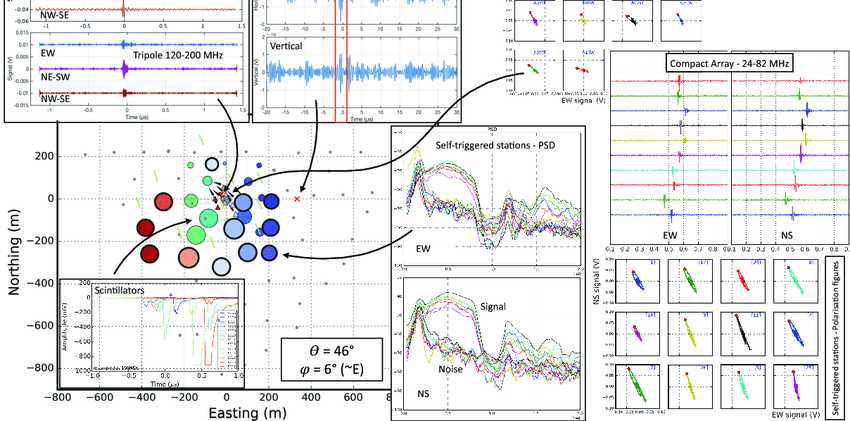
CODALEMA radio detection diagram (Nançay Radio Observatory / CODALEMA) shows detection of
Comsmic Ray induced air showers. The Codelema array consists of many independent telescopes that each detect radio flashes.
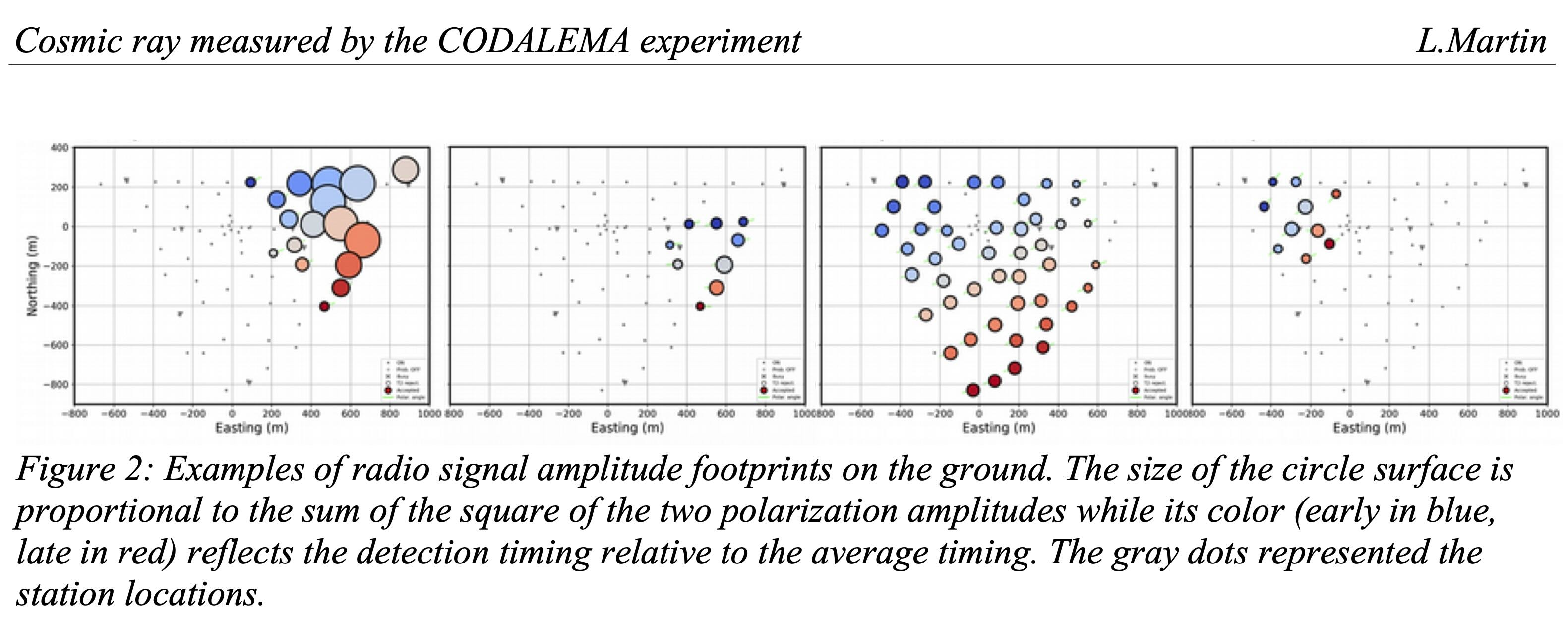
CODALEMA
antenna array used to detect radio pulses from air showers. Different cosmic rays are detected by different antennas, earlier or later depending on the direction of travel of the cosmic ray. Notice that cosmic ray radio flashes are only detected over small regions. Each telescope makes a unique contribution to the measurement of cosmic ray energy and direction.
The Pierre Auger Observatory
The Pierre Auger Observatory in Argentina is the world’s largest cosmic‑ray
detector, combining particle detectors, fluorescence telescopes, and radio antennas.
The research group has made imporant contributions to cosmic ray research.
See for a description of their most recent discoveries and to access their measurements.
we also plan to make all transient event detections available in real time.
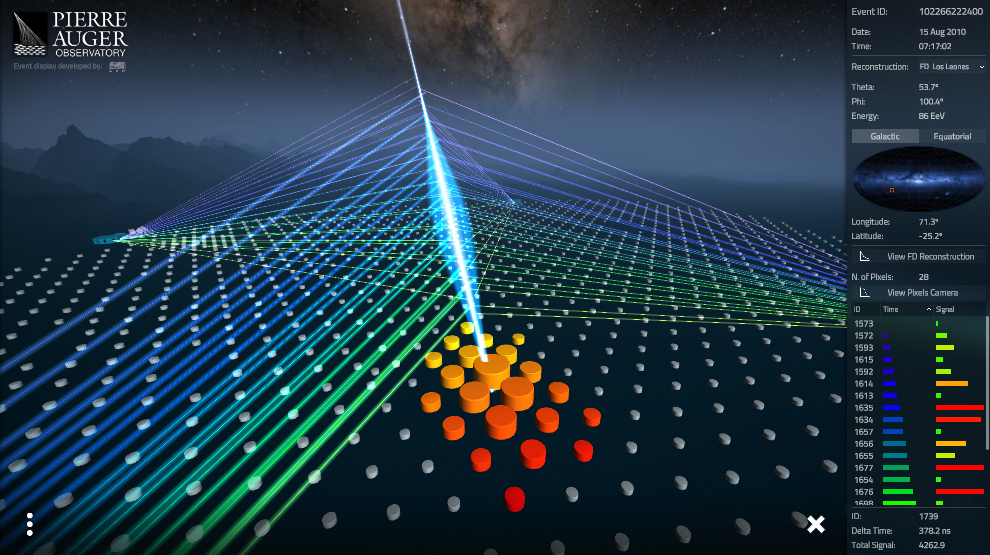
Auger Observatory highest energy multi-eye hybrid event in the UHECR catalog, PAO100815 (id 102266222400): the reconstructed zenith angle is 54° , the energy 82 EeV. It triggered 22 stations of the surface detector and four fluorescence detectors.
Surface detector array of the Pierre Auger Observatory ( auger.org).
The design of the antenna for detection of cosmic rays is important. For the 30-80 MHz
observations, they had to consider both sensitivity and practicality of the entire system.
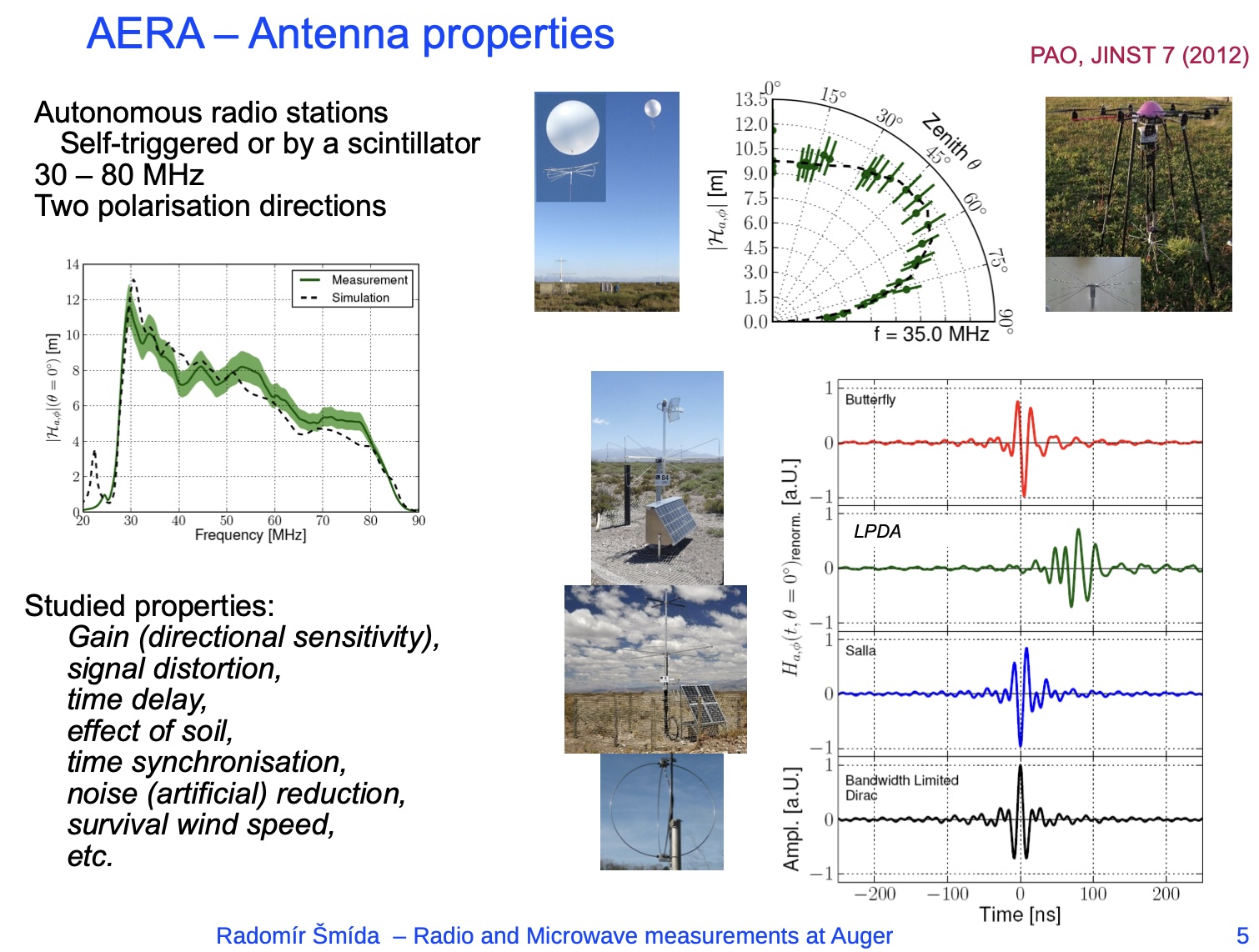
The Auger team chosea "butterfly" antenna design for each station, which was mounted on
a pole and had maximum sensitivity at about 45 degrees elevation. Each of the stations
had a solar panel and battery for independent operation. See presentation by Smida
(2016)
AERA radio antennas at the Pierre Auger Observatory, used to detect radio flashes
Constraining Cosmic‑Ray Sources
By measuring the radio footprint, shower geometry, and depth of shower maximum,
researchers can infer the mass, energy, and arrival direction of the primary cosmic ray.
These measurements help identify whether cosmic rays originate from supernova remnants,
active galactic nuclei, or other extreme astrophysical environments.
Years of Observations
We provide a log of several years of monitoring the sky with Horn Radio Telescopes. The links below access the matches found for these years of observations.
2025 Observations
We make all detected events available for 2025.
These data are organized by month and year. For each month, there is a short video sequence of events detected each month.
Note that the event detection rate is episodic, with many events some days and none detected on others.
We are in the process of making events available for 2026.
Again, for these data are organized by month and year. For each month, there is a short video sequence of events detected each month.
Note that the event detection rate is episodic, with many events some days and none detected on others.