![[Cosmic Search Main Menu]](burnell_files/header.gif) Cosmic Search Vol. 1, No. 1
Little Green Men, White Dwarfs or Pulsars?
By S. Jocelyn Bell Burnell
|
|
In all the history of radio astronomy the pulsing signals discovered at Cambridge, England, in 1967 were the most suggestive of an extraterrestrial intelligent origin that have ever been detected. In this article, Jocelyn Bell Burnell tells a delightful, personal story of how she first encountered the signals and what ensued.-Eds.
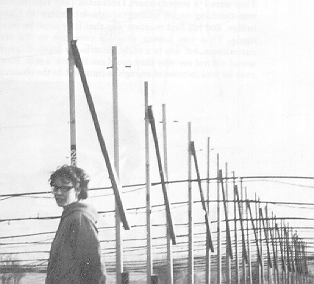
Ladies and Gentlemen: Before you discover for yourselves let me tell you that I am no expert at after dinner speeches. The nearest I have come was writing a Ph.D. thesis; my supervisor kindly read a draft of it and advised me that it read more like an after-dinner speech than a Cambridge University dissertation. He was right, of course, but it has taken me years to see the funny side of his remark. There has been a lot of interest shown in the discovery of pulsars, and also some misunderstanding. I would like to take this opportunity of setting the record straight. However, it all happened 8 or 9 years ago, and after such a time there is some difficulty in remembering it all accurately. The story began in the mid-1960's, when the technique of interplanetary scintillation (IPS) was discovered. IPS is the apparent fluctuation in intensity of the radio emission from a compact radio source. It is due to diffraction of the radio waves as they pass through the turbulent solar wind in interplanetary space. Compact radio sources, e.g. quasars, scintillate more than extended radio sources. Professor Tony Hewish realized this technique would be a useful way of picking out quasars, and designed a large radio telescope to do this. I joined him as a Ph.D. student when construction of this telescope was about to start. The telescope covered an area of 41/2 acres - an area that would accommodate 57 tennis courts. In this area we put up over a thousand posts, and strung more than 2000 dipoles between them. The whole was connected up by 120 miles of wire and cable. We did the work ourselves - about five of us - with the help of several very keen vacation students who cheerfully sledge-hammered all one summer. It took two years to build and cost about E15,000, which was cheap even then. We started operating it in July 1967, although it was several months more before the construction was completely finished. I had sole responsibility for operating the telescope and analyzing the data, with supervision from Tony Hewish. We operated it with four beams simultaneously, and scanned all the sky between declinations +50' and -10' once every four days. The output appeared on four 3-track pen recorders, and between them they produced 96 feet of chart paper every day. The charts were analyzed by hand by me. We decided initially not to computerize the output because until we were familiar with the behavior of our telescope and receivers we thought it better to inspect the data visually, and because a human can recognize signals of different character whereas it is difficult to program a computer to do so. After the first few hundred feet of chart analysis I could recognize the scintillating sources, and I could recognize interference. (Radio telescopes are very sensitive instruments, and it takes little radio interference from nearby on earth to swamp the cosmic signals; unfortunately, this is a feature of all radio astronomy.) Six or eight weeks after starting the survey I became aware that on occasions there was a bit of "scruff' on the records, which did not look exactly like a scintillating source, and yet did not look exactly like man-made interference either. Furthermore I realized that this scruff had been seen before on the same part of the records - from the same patch of sky (right ascension 1919). The source was transiting during the night - a time when interplanetary scintillation should be at a minimum, and one idea we had was that it was a point source. Whatever it was, we decided that it deserved closer inspection, and that this would involve making faster chart recordings as it transited. Towards the end of October when we had finished doing some special test on 3C273, and when we had at last our full complement of receivers and recorders, I started going out to the observatory each day to make the fast recordings. They were useless. For weeks I recorded nothing but receiver noise. The "source" had apparently gone. Then one day I skipped the observations to go to a lecture, and next day on my normal recording I saw the scruff had been there. A few days after that at the end of November '67 I got it on the fast recording. As the chart flowed under the pen I could see that the signal was a series of pulses, and my suspicion that they were equally spaced was confirmed as soon as I got the chart off the recorder. They were 11/3 seconds apart. I contacted Tony Hewish who was teaching in an undergraduate laboratory in Cambridge, and his first reaction was that they must be manmade. This was a very sensible response in the circumstances, but due to a truly remarkable depth of ignorance I did not see why they could not be from a star. However he was interested enough to come out to the observatory at transit-time the next day and fortunately (because pulsarsrarely perform to order)the pulses appeared again. This is where our problems really started. Tony checked back through the recordings and established that this thing, whatever it was, kept accurately to sidereal time. But pulses 11/3 seconds apart seemed suspiciously manmade. Besides 11/3 seconds was far too fast a pulsation rate for anything as large as a star. It could not be anything earth-bound because it kept sidereal time (unless it was other astronomers). We considered and eliminated radar reflected off the moon into our telescope, satellites in peculiar orbits, and anomalous effects caused by a large, corrugated metal building just to the south of the 41/2 acre telescope.
"Were these pulsations man-made, but by man from another civilization?"
Then Scott and Collins observed the pulsations with another telescope with its own receivers, which eliminated instrumental effects. John Pilkington measured the dispersion of the signal which established that the source was well outside the solar system but inside the galaxy. So were these pulsations man-made, but made by man from another civilization? If this were the case then the pulses should show Doppler shifts as the little green men on their planet orbited their sun. Tony Hewish started accurate measurements of the pulse period to investigate this; all they showed was that the earth was in orbital motion about the sun. Meanwhile I was continuing with routine chart analysis, which was falling even further behind because of all the special pulsar observations. Just before Christmas I went to see Tony Hewish about something and walked into a high-level conference about how to present these results. We did not really believe that we had picked up signals from another civilization, but obviously the idea had crossed our minds and we had no proof that it was an entirely natural radio emission. It is an interesting problem - if one thinks one may have detected life elsewhere in the universe how does one announce the results responsibly? Who does one tell first? We did not solve the problem that afternoon, and I went home that evening very cross here was I trying to get a Ph.D. out of a new technique, and some silly lot of little green men had to choose my aerial and my frequency to communicate with us. However, fortified by some supper I returned to the lab that evening to do some more chart analysis. Shortly before the lab closed for the night I was analyzing a recording of a completely different part of the sky, and in amongst a strong, heavily modulated signal from Cassiopea A at lower culmination (at 1133) 1 thought I saw some scruff. I rapidly checked through previous recordings of that part of the sky, and on occasions there was scruff there. I had to get out of the lab before it locked for the night, knowing that the scruff would transit in the early hours of the morning. So a few hours later I went out to the observatory. It was very cold, and something in our telescope-receiver system suffered drastic loss of gain in cold weather. Of course this was how it was! But by flicking switches, swearing at it, breathing on it I got it to work properly for 5 minutes - the right 5 minutes on the right beam setting. This scruff too then showed itself to be a series of pulses, this time 1.2 seconds apart. I left the recording on Tony's desk and went off, much happier, for Christmas. It was very unlikely that two lots of little green men would both choose the same, improbable frequency, and the same time, to try signalling to the same planet Earth. Over Christmas Tony Hewish kindly kept the survey running for me, put fresh paper in the chart recorders, ink in the ink wells, and piled the charts, unanalyzed, on my desk. When I returned after the holiday I could not immediately find him, so settled down to do some chart analysis. Soon, on the one piece of chart, an hour or so apart in right ascension I saw two more lots of scruff, 0834 and 0950. It was another fortnight or so before 1133 was confirmed, and soon after that the third and fourth, 0834 and 0950 were also. Meanwhile I had checked back through all my previous records (amounting to several miles) to see if there were any other bits of scruff that I had missed. This turned up a number of faintly possible candidates, but nothing as definite as the first four.
"It is an interesting problem..... if one thinks one may have detected life elsewhere..... how does one announce the results responsibly?"
At the end of January the paper announcing the first pulsar was submitted to Nature. This was based on a total of only 3 hours' observation of the source, which was little enough. I feel that comments that we kept the discovery secret too long are wide of the mark. At about the same time I stopped making observations and handed over to the next generation of research students, so that I could concentrate on chart analysis, studying the scintillations and writing up my thesis. A few days before the paper was published Tony Hewish gave a seminar in Cambridge to announce the results. Every astronomer in Cambridge, so it seemed, came to that seminar, and their interest and excitement gave me a first appreciation of the revolution we had started. Professor Hoyle was there and I remember his comments at the end. He started by saying that this was the first he had heard of these stars, and therefore he had not thought about it a lot, but that he thought these must be supernova remnants rather than white dwarfs. Considering the hydrodynamics and neutrino opacity calculations he must have done in his head, that is a remarkable observation! In the paper to NATURE we mentioned that at one stage we had thought the signals might be from another civilization. When the paper was published the press descended, and when they discovered a woman was involved they descended even faster. I had my photograph taken standing on a bank, sitting on a bank, standing on a bank examining bogus records, sitting on a bank examining bogus records: one of them even had me running down the bank waving my arms in the air - Look happy dear, you've just made a Discovery! (Archimedes doesn't know what he missed!) Meanwhile the journalists were asking relevant questions like was I taller than or not quite as tall as Princess Margaret (we have quaint units of measurement in Britain) and how many boyfriends did I have at a time?
"Look happy dear, you've just made a Discovery."
That was how my part in the proceedings ended. I finally finished the chart analysis, measured the angular diameters of a number of radio sources, and wrote my thesis. (The pulsars went in an appendix.) Then I moved out of the field to another part of the country, to get married. It has been suggested that I should have had a part in the Nobel Prize awarded to Tony Hewish for the discovery of pulsars. There are several comments that I would like to make on this: First, demarcation disputes between supervisor and student are always difficult, probably impossible to resolve. Secondly, it is the supervisor who has the final responsibility for the success or failure of the project. We hear of cases where a supervisor blames his student for a failure, but we know that it is largely the fault of the supervisor. It seems only fair to me that he should benefit from the successes, too. Thirdly, I believe it would demean Nobel Prizes if they were awarded to research students, except in very exceptional cases, and I do not believe this is one of them. Finally, I am not myself upset about it - after all, I am in good company, am I not! All this happened 8 or 9 years ago, and to show that I operate in real time I would like to end by telling you what it is like to be on the inside in x-ray astronomy at the moment. When I left radio astronomy and went into gamma-ray astronomy I told myself firmly that I had already had more than a lifetime's share of excitement and good luck and that I must settle down now and do some reliable and solid, undramatic science, though hopefully it would be interesting science. And certainly gamma-ray astronomy was suitably unspectacular (although I cannot help noticing how it has improved since I left the field three years ago). Then I went to MSSL and into x-ray astronomy, still telling myself that I had already had more than a lifetime's share . . . . . . . I had not appreciated that x-ray astronomy was about to boom, and had not reckoned on the excitement of participating in a satellite project in those sorts of circumstances. Life with a satellite is hectic: it never stops, nor takes holidays or weekends off - it keeps going, day in, day out. If you are not careful it runs you instead of you running it. If somebody could invent a Lord's Day Observance satellite, I would be pleased to work on it. I mentioned earlier the 31/2 miles of chart recordings from the radio telescope that I analyzed. The data from our experiments on Ariel V now cover 12 miles of computer printout, and the bird is still flying. One hears about information explosions, but it is only when one happens all around you that you appreciate what it is. Within the lifetime of Ariel V - the last two years new, dramatic results have been rolling in thick and fast. X-ray transients have come to stay; many x-ray sources are found to be highly variable; periodicities on a time-scale of minutes have been discovered; more recently still x-ray bursts have opened our eyes to yet another type of phenomenon; and x-ray emission from galaxies and clusters of galaxies is now well established. What will the Universe throw at us next? There is now a thirteenth commandment "Thou shalt not make predictions in x-ray astronomy, lest the Lord thy God reveal the folly of thy ways unto all."
This article was presented as an after-dinner speech with the title of "Petit Four" at the Eighth Texas Symposium on Relativistic Astrophysics and appeared in the Annals of the New York Academy of Science, vol. 302, pages 685-689, Dec., 1977. Reproduced by permission.
|
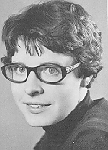 S. Jocelyn Bell Burnell
was born in northern Ireland in 1943. After receiving a B.S. degree in physics
from Glasgow University, Scotland, she went to Cambridge University, England,
where she earned her doctorate in radio astronomy in 1969. Since then she
has done research in the newest branches of astronomy involving gamma-rays
and x-rays. In 1978 she received the American Tentative Society Award for
her pulsar research. Currently she is a research scientist at the Mullard
Space Science Laboratory of the University College London.
S. Jocelyn Bell Burnell
was born in northern Ireland in 1943. After receiving a B.S. degree in physics
from Glasgow University, Scotland, she went to Cambridge University, England,
where she earned her doctorate in radio astronomy in 1969. Since then she
has done research in the newest branches of astronomy involving gamma-rays
and x-rays. In 1978 she received the American Tentative Society Award for
her pulsar research. Currently she is a research scientist at the Mullard
Space Science Laboratory of the University College London.