Observations were made of several calibration sources at 22.236 GHz using the 18-22 GHz receiver. Peak and focus scans were done, as well as tipping scans. The weather was mostly clear with temperatures near 20 F. The observing session was from 05:00 to 14:00 UT ( or 0h to 9h local time). The K-band receiver has 4 feeds; but for these observations we only used feed number one.
Pointing model 4c was in use, and the active surface corrections used the FEM model.
The following sources were observed:| Source | num peak seqs | elevation range |
|---|---|---|
| 3C48 | 7 | 9 - 15 |
| 3C147 | 4 | 29 - 31 |
| 3C286 | 45 | 9 - 81 |
| 3C295 | 24 | 21 - 76 |
| 3C309.1 | 3 | 55 - 55 |
| 0403+768 | 4 | 27 - 27 |
| 0858-279 | 4 | 23 - 23 |
| 1151-348 | 4 | 16 - 16 |
| 1345+125 | 4 | 63 - 63 |
| 1358+624 | 3 | 53 - 53 |
Peak sequences consist of 4 scans: forward and reverse in azimuth, then forward and reverse in elevation, centered on the source position. After the azimuth scans, a correction is made to the local pointing correction (LPC), so that the elevation scans go through the true source position. Focus scans were done several times during the observing session to touch up the focus offset. Amplitude calibration was done by injecting a calibrated noise signal (Tcals) at a 10 Hz rate. Gaussians were fit to each cross scan, and peak values and system temperatures calculated.
The program "prepoint" was used to extract the calibrated peak data.
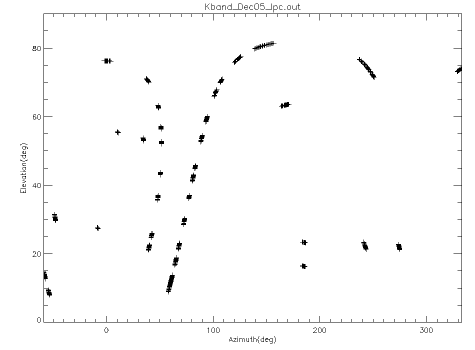
Figure 1 shows the coverage of azimuth and elevation.
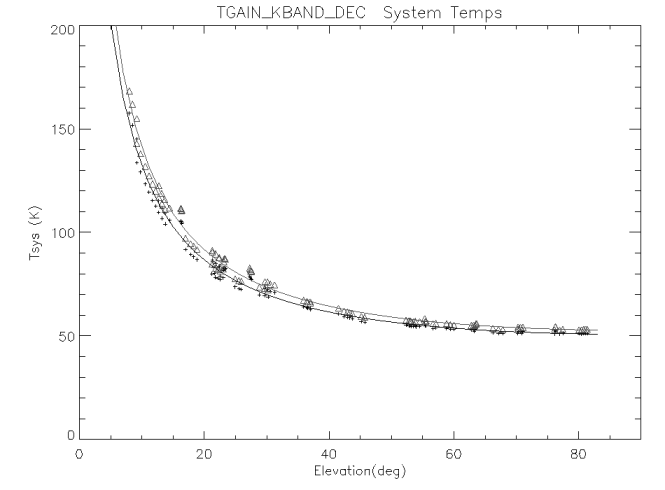
Figure 2 shows the system temperatures (Tsys in Kelvin) plotted versus elevation. LCP data plotted as plusses, and RCP data as triangles. In Figure 2, we also plot the fitted curves in Tsys vs opacity of the form:
| LCP (K) | RCP (K) | |
|---|---|---|
| Tcal | 5.213 | 4.333 |
| T0 | 30.06 (0.39) | 30.43 (0.39) |
| Tatm | 322.0 (17.8) | 360.2 (19.2) |
| &tau | 0.0662 (0.0046) | 0.0636 (0.0042) |
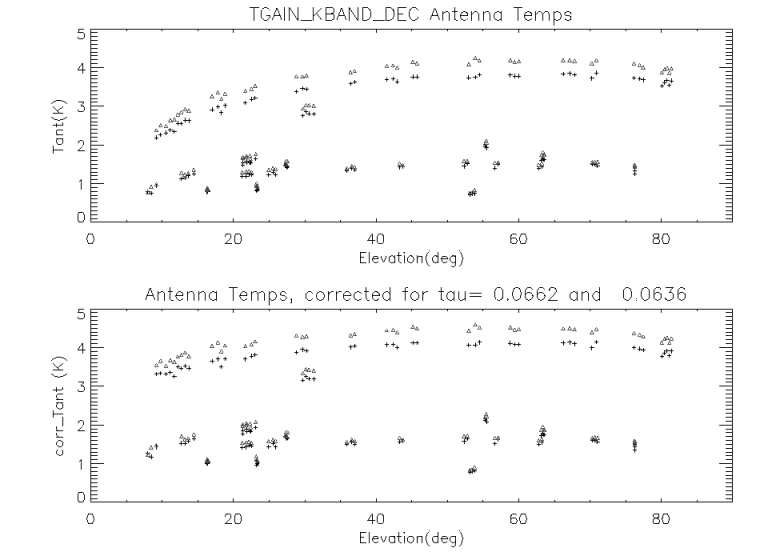
In the upper panel of Figure 3 we plot Tant for all sources. In the lower panel Tant is shown after correction for opacity:
| Source | Flux Density (Jy) at 22.236 GHz |
|---|---|
| 3C48 | 1.131 |
| 3C147 | 1.815 |
| 3C286 | 2.540 |
| 3C295 | 0.941 |
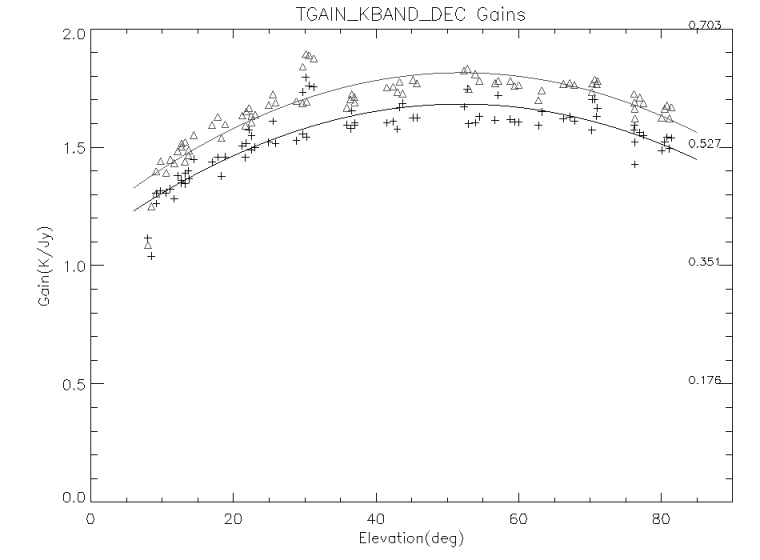
The parameters of the fitted curves are as follows; the rms error is the rms of the data with respect to the fitted curves.
| LCP | RCP | |
|---|---|---|
| Gmax | 1.682 K/Jy | 1.815 K/Jy |
| ApEff | 59% | 64% |
| A0 | 0.815 | |
| A1 | 0.00970 | |
| A2 | -1.273e-4 | |
| rms error | 0.067 K/Jy | |
Note that we do not believe that the efficiencies should be different for the two polarizations. This disrepancy must be due to uncertainties in the calibration temperatures (Tcals).