The GBT LO system (see description of LO1 FITS file) provides for adjusting the local observing frequency to track the velocity of an astronomical object.
The user needs to specify:
The user also specifies a frequency tolerance (Ftol), i.e., by how many Hz must the topocentric frequency change before the LO is updated.
These four parameters are described in the following paragraphs.
Note that aips++ does not support Heliocentric, Local Group, or CMB frames. These frames should be avoided if you are using aips++ to display and process your data.
The JPL ephemeris is used to calculate the motion of the solar system barycenter and of the center of the sun (Heliocentric). Heliocentric velocities differ by no more than 0.02 km/sec from the solor system barycenter. For many purposes they can be regarded as equivalent. In general the barycenter is preferred, since it is the best approximation to an inertial reference frame in the solar system vicinity.
For the other frames of reference, the "Definition" column in Table 1 gives the definition of this frame as given in the literature. The "J2000 Vector" column gives the velocity vector between the solar system barycenter and the frame in terms of J2000 coordinates. For convenience, this J2000 vector is what is actually used by the LO1 system to convert between the specified frame and the barycenter.
Table 1: Velocity Frames
These are the frames implemented in the GBT LO1 manager as of 2002.
| Frame | Description | Definition | J2000 Vector from Barycenter |
Reference |
| Local (Topocentric) | The LO is fixed: no tracking | GBT Location:
38° 25'59.23"N; 79° 50'23.40"W; Height: 855.6m |
--- | --- |
| Barycentric | Solar System Barycenter | JPL Ephemeris DE403 | --- | --- |
| Heliocentric | Center of Sun | JPL Ephemeris DE403 | --- | --- |
| Kinematic LSR | Conventional Local Standard of Rest based on average velocity of stars in the Solar neighborhood | Solar motion = 20.0 km/sec towards (18h +30°) at epoch 1900.0 | 20.0 km/sec towards (18h03m50.29s, +30°00'16.8") | Gordon (1975) |
| Dynamical LSR | Solar peculiar velocity with respect to a frame in circular motion about the galactic center | Solar motion vector = (-9, +12, +7) km/sec in Galactic cartesian coordinates. | 16.55294 km/sec towards (17h49m58.667s, +28°07'03.96") | Delhaye (1965) |
| Galactocentric | Dynamical center of the galaxy. | The Dynamical LSR moves 220 km/sec towards ( l=90°, b=0°) | 232.3 km/sec towards (20h55m26.77s, +47°49'23.5") | Kerr and Lynden-Bell (1986) |
| Local Group | Mean motion of Local Group Galaxies | Solar Motion = 308 km/sec towards (l=105°, b=-7°) |
308 km/sec towards (22h53m14.55s, +51°42'32.2") | Yahil et al. 1977 |
| Cosmic Microwave Background | COBE measurements of dipole anisotropy | Solar motion = 369.5 km/sec towards (l=264.4°, b=48.4°) |
369.5 km/sec towards (11h12m56.40s -06°57'50.0") | Kogut et al. 1993 |
Table 2: References
| Delhaye (1965) | "Solar Motion and Velocity Distribution of Common Stars," by J. Delhaye, pages 73-74, in "Stars and Stellar Systems, Volume 5: Galactic Structure", ed. Blaauw and Schmidt, Univ. of Chicago Press (1965). |
| Gordon (1975) | "Computer Programs for Radio Astronomy,"
by M.A.Gordon, page 281, in " Methods of Experimental Physics: Volume 12: Astrophysics, Part C: Radio Observations", ed. M.L.Meeks, Academic Press 1976. |
| Kerr and Lynden-Bell (1986) | "Review of galactic constants", by F.J.Kerr and
D. Lynden-Bell. Mon.Not.Roy.Astron.Soc. vol.221, p.1023 (1986) |
| Kogut et al. (1993) | "Dipole Anisotropy in the COBE Differential Microwave Radiometers
First-year Sky Maps," by A. Kogut, C. Lineweaver, G. F. Smoot,
C. L. Bennett, A. Banday, N. W. Boggess, E.S.Cheng,
G. De Amici, D.J.Fixsen, G.Hinshaw, P.D.Jackson, M.Janssen,
P.Keegstra, K. Loewenstein, P.Lubin, J.C.Mather, L.Tenorio,
R.Weiss, D.T.Wilkinson, and E.L.Wright. Astrophys.J. vol.419, p.1, December 10, 1993. |
| Yahil et al. (1977) | "The Local Group: the Solar Motion Relative to its Centroid," A.Yahil, G.A. Tammann, and Allan Sandage, Astrophys.J. vol.217, p.903, November 1, 1977. |
Table 3 summarizes these conventions. 'Redshift' means the user specifies the redshift parameter 'z'; this implies the optical convention with V = cz. f0 is the rest frequency. V is the velocity component along the line of sight to the object.
The sign convention for velocity is such that V>0 for recession, i.e., increasing velocity means decreasing frequency.
Table 3: Velocity Definitions.
| Velocity Definition | Velocity Formula | Conversion to Frequency |
| Radio | V = c (f0 - f)/f0 | f(V) = f0 ( 1 - V/c ) |
| Optical | V = c (f0 - f)/f | f(V) = f0 ( 1 + V/c )-1 |
| Redshift | z = (f0 - f)/f | f(V) = f0 ( 1 + z )-1 |
| Relativistic | V = c (f02 - f 2)/(f02 + f 2) | f(V) = f0 { 1 - (V/c)2}1/2/(1+V/c) |
The full special relativistic conversion is given by:
f = f0 { 1 - (V/c)2 }1/2 / (1 + V· S /c)
The formula given in the table is the case in which the velocity is along the line of sight, i.e, V = V· S , because in most cases we do not know the transverse velocity of the source.
Next, the vector velocity Vb of the solar system
barycenter with respect to the local (GBT) frame is calculated
using the JPL ephemeris.
The velocity Vf of the specified frame with respect
to the barycenter is taken from Table 1 ("J2000 Vector from Barycenter").
The resulting Vframe (topocentric to Vref) is given by
Vframe = Vb + Vf .
The conversion to topocentric frequency Ftop is then calculated with the relativistic formula:
Ftop = f1{ 1 - (Vframe/c)2}1/2/(1 + Vframe· S/c)
Where Vframe is the magnitude of the vector Vframe.
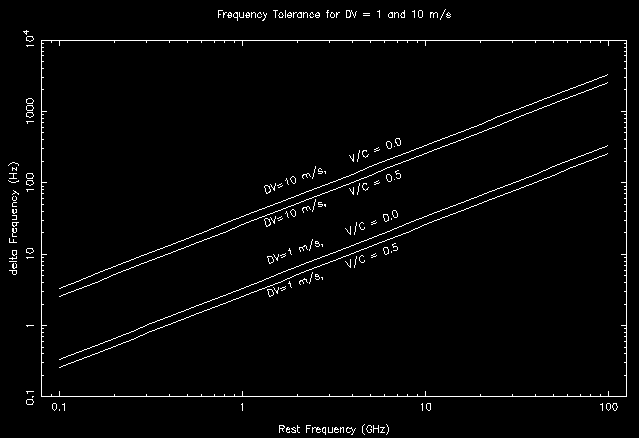
For low velocities, the relation between a frequency change DF and the corresponding velocity change DV is given by:
(1) DF = (f0/c) DV
In general, using the relativistic formula:
(2) DF = (f0/c) DV (1+b)-1 (1 - b2)-1/2
One can use the following graphs to select Ftol. DF is plotted versus rest Frequency f0 for two cases of velocity resolution DV=10m/s and DV=1m/s and for b = 0.0 and 0.5.
Table 5. Reference Frames and alternates
| Frame | Definition | Galactic (l2,b2) | J2000 α,&delta
wrt Bary | J2000 cartesian wrt Bary | used ? |
|---|---|---|---|---|---|
| kinematic LSR | Solar motion 20.0 km/sec towards (18h +30°), epoch 1900.0
(Gordon 1975) |
56.16°, +22.76° | 20.0km/s, 18:03:50.24, +30:00:16.8 | (0.28998, -17.31727, 10.00141) km/sec | GBT/LO1; slalib |
| dynamic LSR | Solar motion 16.553 km/sec; vector=(+9,+12,+7) in Galactic cartesian coordinates.
(Delhaye 1965) |
53.13°, +25.17° | 16.55km/s, 17:49:58.66, +28:07:03.92 | (-0.63823, -14.58542, +7.80116) | GBT/LO1; slalib |
| Galactocentric | Dynamical LSR moves 220km/sec towards l2,b2=90,0 (Kerr&Lynden-Bell 1986) |
90°, 0° | 232.3km/s, 20:55:26.77, +47:49:23.5 | (108.06585 -112.44793 172.13725) | GBT/LO1; slalib |
| Galactocentric | Dynamical LSR moves 254km/sec towards l2,b2=90,0 (Reid etal 2009) |
90°, 0° | 266.2km/s, 20:57:32.57, +47:53:46.0 | (124.86557 -127.57214 197.53465) | |
| Local Group | Solar Motion 300km/sec towards l2,b2=(90,0)
(deVaucouleurs, IAU 1976) | 90°, 0° | 300km/sec, 21:12:01.05, 48:19:46.71 | (148.23284 -133.44888 224.09467) | GBT/LO1; slalib |
| Local Group | Solar Motion 308km/sec towards l2,b2=(105,-7)
(Yahil et al 1977) | 105°, -7° | 308km/sec, 22:53:14.58, 51:42:32.20 | (182.81476 -54.80956 241.74092) | |
| Local Group | Solar Motion 306km/sec towards l2,b2=(99,-4)
(Courteau&vandenBergh 1999) | 99°, -4° | 306km/sec, 22:10:24.03, 51:13:54.19 | (170.11341 -88.17782 238.58352) | |
| Cosmic microwave background (COBE) | Solar motion 369.5km/sec towards l2,b2=264.4,48.4.
COBE (Kogut et al 1993) | 264.4°, 48.4° | 369.5km/s, 11:12:56.43, -06:57:50.0 | (-359.06915 74.78365 -44.79956) | GBT/LO1 |
| Cosmic microwave background (WMAP) | Solar motion 368.0km/sec towards l2,b2=263.85,48.25
WMAP (Bennett et al 2003) | 263.85°, 48.25° | 368km/s, 11:11:22.92, -06:52:57.02 | (-357.15833 76.92350 -44.09881) |
Table 6. References
| FITS WCS paper 3: Greisen et al.(A&A 446: 747, 2006) | |
| WMAP: Bennett et al 2003 (ApJSupp 148:1) | |
| Local Group: Courteau & van den Bergh 1999 (AJ 118: 337) | |
| Local Group: deVaucouleurs 1976 : IAU Transactions 16B, 201. | |
| Galactic: Reid et al 2009 (ApJ 700: 137) |