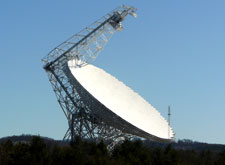
Ka-band Update For The 10A GBT Call for Proposals
Current Status of the Ka-band (26-40 GHz) Receiver
In the winter of 2009, observations with the Zpectrometer noticed a change in the noise characteristics of the GBT Ka-band receiver at a level of approximately 2 mK. The noise level continues to integrate down below 2 mK but at a rate that is about ten times slower than the theoretical noise limit. The Ka-band receiver was taken off the telescope in April 2009 to investigate the problem.
The NRAO staff, with significant help from A. Harris (UMd) made extensive tests of the Ka system during the Summer of 2009. The stability of the receiver was checked as each component was added to the system moving from the IF output of the receiver towards the feed horns of the receiver.
The Ka-band receiver shows excellent gain stability when all components of the system are assembled (on order of 100 seconds or more) but with waveguide terminations in place of the feed horns. Once the feeds horns are installed, instabilities on time scales of tens of seconds or less appear. Several types of feedhorns have been used, with similar results. Tests indicate that interactions between the feed horns, the vacuum window, the weather radome, and other environmental factors lead to the instabilities.
Plans Forward
Tests have shown that the receiver can achieve stability on time scales of 50-100 seconds without the Teflon radome in place. (It should be noted that the radome protects the receiver from moisture and precipitation from the ambient weather.) In October 2009 we plan a final test of replacing the Ka-band vacuum window and radome with a rigid structure that will act as both the vacuum window and radome. Improvements to the cryostat internal mechanical stiffness will also be made. After these tests the Ka-band receiver will be installed on the GBT for winter observing. Updates on the stability of the receiver will be presented on this web page as they become available (no later than the end of October 2009).
We are also continuing to look into the higher than expected noise in the Ka receiver, and will provide updates to the receivers status.
Proposal Guidelines for the GBT 10A Call for Proposals
All proposals that use the Ka-band receiver for the GBT 10A call for proposals should use the system temperatures indicated in the Proposer's Guide to calculate the theoretical noise. Experience has shown that for the CCB the noise will be approximately 1.3 times theoretical which requires a factor of 1.7 times more observing time to reach the theoretical noise limit. This is also true when observing narrow spectral lines with the GBT spectrometer (see GBT Memo #255). The Zpectrometer and GBT spectrometer (when used to observe broad spectral lines) will encounter a noise level that is approximately a factor of 2 higher than the theoretical noise limit. This will require a factor of 4 more observing time to reach the theoretical noise limit (see GBT Memo #259). (The larger noise for the Zpectrometer and GBT spectrometer for broad lines results from baseline structures on scales smaller than the spectral resolution of the data.) All proposals should take into account the fact that the actual noise will be greater than the theoretical noise.
Wide spectral line observations using the Zpectrometer or the GBT spectrometer should plan on using sub-reflector nodding using a 10 second cycle time. Narrow line GBT spectrometer observations can use either sub-reflector nodding or "regular" nodding (dual-beam position switching with one beam always on source). Additional overhead time must also be included in the proposed observing time. Please see the Proposer's Guide for details and guidelines on estimating overhead time.
Update - Oct 19, 2009
The mounting of the receiver within the dewar has been made more rigid to reduce mechanical vibrations. A rigid vacuum window/radome cover has successfully held vacuum. This has improved the time scale for the instabilities some.
Currently it is thought that the metal parts that make up the heat shielding, dewar and radome assembly are playing a role in the instabilities. Without these parts the receiver achieves minimum stability time-scale of 50 seconds. Work is progressing to isolate the components that are the source of the instabilities.
Update - Feb 1, 2010
A meeting was held in late January to decide the fate of the receiver. The receiver will be installed on the GBT on Feb 25, 2010. The goal is for the receivers performance to match the performance it had in the spring of 2009. The receiver should become available for general observations by about mid-March 2010.
One remaining option that could improve the performance of the receiver is to use 90 degree hybrids instead of 180 degree hybrids. We are currently investigating this option. We will make a decision on the 90 degree hybrid option by summer 2010. If we go this route the receiver would not be available from the summer of 2010 until early 2011.
Update - Mar 14, 2010
The Ka receiver has been checked out with the CCB. The data collected were within the realm of what was to be expected. All Ka continuum observations are now being allowed to be scheduled by the DSS system.
The Ka receiver has also been checked out with the spectrometer. Data analysis is still underway. Narrow spectral lines observations will be possible and proposals fitting this category will be allowed to be scheduled by the DSS system in the very near future.
An email will be sent to all PIs of Ka projects with a complete desciption of the performance of the receiver once commissioning activities have been completed.
Update - Mar 31, 2010
The results are in! Basically the receiver performance is similar to that of last year. System temperatures are slightly higher. The summary in contained in this document and the following figures: Figure 1 Figure 2 Figure 3
K. O'Neil, T. Minter