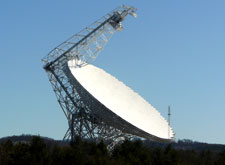
The Green Bank Telescope

The New Dynamic Scheduling System for the GBT


Testing June - September 2008

Introduction           Overview           Benefits of the DSS          Testing the DSS          Summer Schedule 2008          More Information          Questions

Introduction

The GBT spans a larger range of frequencies than other comparable centimeter/millimeter:1 single-dish telescopes, and is located in a continental, mid-latitude region where weather is dominated by water vapor and small-scale effects. As a result, the observing efficiency of the GBT can be enhanced significantly by dynamically scheduling observations best matched to weather conditions.

To date, the GBT has employed a simple form of dynamic scheduling in which two projects, one high-frequency and one low-frequency, are scheduled together in two sessions (spaced typically by two days). The high-frequency observer is allowed to choose which of the sessions he or she would like to use. The other session is used by the low-frequency observer. This scheme often results in high-frequency observers receiving little or no time if they wait for truly high-frequency weather, which compromises the ability to discharge these projects, and could delay completion of low-frequency projects if high-frequency observers choose substandard conditions to execute their observations. Additionally, not all high-frequency programs require the same weather. E.g. weather conditions which may be ideal for K-band observations are not necessarily the best for Q-band, and vice-versa. The new Dynamic Scheduling System (DSS) allows observers to optimally match their desired weather conditions to their observations, resulting in considerably increased observing efficiency.

An improved scheme, and the accompanying software and hardware, for dynamically scheduling science on the GBT is required to make the most efficient use of telescope time, which is in high demand. This must be delivered however in a way which minimizes the burden on the GBT observer. These are the two primary goals of the GBT Dynamic Scheduling System (DSS). A successful implementation of the DSS should increase the average observing efficiency at high frequencies with the GBT (by approximately 50%) while ensuring that the flexibility and ease of use of the GBT is fully retained, and the data quality of observations is not adversely affected.

Overview

A successful implementation of dynamic scheduling will increase the average observing efficiency at high frequencies with the GBT (by approximately 50%) while ensuring that none of the flexibility and ease of use of the GBT is harmed and the data quality of observations is not adversely affected.

One of the primary benefits of single dish radio observations is the ease with which observers can make on-the-fly decisions regarding their data and observing process. Additionally, the GBT was built with the flexibility to allow users to bring in their own hardware for observations, an idea which has proven to be highly successful. As these instruments are not typically fully integrated into the GBT monitor and control software system, users of these instruments need to be able to interact with their hardware in real time during observations.

The flexibility of the GBT (e.g. the ability to observe from 0.3 - 90 GHz, observer-created observing routines and telescope patterns and a large number of observatory supported front and back-ends) means that GBT data quality assurance is a formidable issue. To date the issue has been dealt with by requiring project investigators to acquire the data for their project in real time and so be responsible for the data quality of their own projects. Any move away from this scheme, e.g. to a queue-based system wherein Green Bank staff run an observing project, would require both GB staff having a detailed understanding of the scientific requirements of every project and a data reduction pipeline for all queue based projects (to allow the staff to asses the data quality). While the NRAO E2E division is working toward creating a data reduction pipeline for the most common observing modes on all NRAO telescopes, that pipeline is only getting started. Additionally, Green Bank simply does not have sufficient staff to allow for scientific data quality checks of all, or even most, GBT experiments.

As a result, the GBT DSS team is implementing a dynamic scheduling system which is markedly different from the standard queue-based system that other telescopes use. At the start of a trimester, observers will be asked to indicate when they will be available to observe. Within the time periods observers themselves specify, they will be notified if their project is likely to be run. Notification will be well in advance of the observations. Then every 24 hours the DSS will create a schedule for the GBT from the pool of available projects. At this point, a minimum of 24 hours before their observations start, the relevant observers will be notified that their observations have been placed on the schedule. The weather will then be monitored by the DSS in real time. If at any point the weather has deteriorated such that the scheduled project cannot be run, a back-up project (which has been pre-approved and can be run in the available weather) will be run in its place. The back-up project may be run with the GBT support staff running the experiment and monitoring the data quality, or it may be run by a project investigator who has agreed to be notified at the last minute, depending on the wishes of the project investigators and the complexity of the project.

One of the components of the GBT DSS, which will both improve the ease of use of the GBT and make the DSS plans feasible, is the implementation of an observer's availability calendar for each project. With this calendar each observer can note the times he or she cannot be available for observing, blocking anything from an hour to months. The exciting part of this system is that any observer can update it at any time as that information will be immediately and automatically fed into the scheduling software. As a result, it will be extremely easy for observers to make sure that GBT observing does not conflict with any other commitment. It should be noted also that the DSS team is looking into the best method for notifying observers of the probability of their projects being scheduled over a ~1 week period, which will aid observers in knowing when they may be scheduled on the telescope.

There are, of course, many other details to the GBT DSS, such as the ability to schedule monitoring and fixed time observations, a ranking scheme for scheduling the projects, etc. All these details are publicly available through the Project Main Page and the DSS Memo series.

Benefits of the GBT DSS

In addition to improving the observing efficiencies for high-frequency observers, the DSS will allow for more flexible use of the GBT. This will benefit both high and low-frequency observers in many ways, including:

  • Observations affected by transient RFI can be halted and seamlessly rescheduled;
  • System faults (both in hardware and software) will be easier to work around and fixes will be easier to schedule, making the running of the GBT smoother and more efficient;
  • Any "make-up time" needed for a project will be easily rescheduled, allowing the observations to be completed within the requested trimester;
  • Rapid Response Proposals will be scheduled without disrupting another observer's scheduled time;
  • Observers will be able to state when they wish to travel to Green Bank for observations, rather than being told by the telescope scheduler when to arrive;
  • Observers will be able to change their availability for observing even as the trimester progresses rather than only a few months before a trimester begins
  • Observers will be able to block out many small amounts of available time (e.g. when teaching classes) rather than needing to adjust their personal schedule to a pre-set telescope schedule;
  • Observers will have the ability to observe a small part of their allotted time and then request a few days (or more) to analyze the data before using more telescope time;
  • Complicated monitoring programs will be easily handled by the DSS;
  • The GBT scheduling process will be transparent, allowing users to discern the likelihood of attaining telescope time as the trimester progresses.
The main goal of the DSS project is the complete adoption of an easy to use, significantly improved and more efficient dynamic scheduling system for all GBT telescope time. This includes delivery of all the tools necessary to make dynamic scheduling possible. While developing these tools, we will strive to keep ease of use high for observers, investigators, and support staff.

Testing the GB DSS (2008)

Release of the DSS is not planned until late 2009. However, a prototype of the new DSS will be tested during the GBT's 08B trimester (beginning June 1, 2008). All observers taking part in the test will be encouraged to provide feedback on their experience. This feedback will allow the DSS team to ensure that when the system is fully deployed, it is readily usable by all GBT observers. All observers applying for time at the Feb 1, 2008 proposal deadline should be prepared to participate in this exercise.

The DSS tests will result in no change to the proposal preparation and submission process. Once the refereeing process is complete, all information available from the proposal submission tool (PST) and pertinent for the DSS will be collected from the successful proposals. At this point project investigators will be contacted on how to modify the information brought over from the PST to ensure all information in the DSS database is correct and to make any modifications to that data which are desired. This will allow for accurate and efficient scheduling of the accepted projects.

GBT staff will, as always, be available to help observers both in working with the observing information in the DSS database and also with understanding the new dynamic scheduling scheme. It should be noted that the DSS alters only the scheduling process for the GBT and will not affect the observing interface (e.g. Astrid) in any way.

Summer Schedule

  • May 12: Release of database interface for all projects to be scheduled during 08B triemester;
  • May 12: Release of database interface for all user contact information and blackout dates;
  • May 12: Releaseof all project pages with scheduling probabilities;
  • June 1: Release of first DSS schedule, for time starting 18:00 on June 2;
  • Sept. 30: End of DSS test;

More Information

Questions

    about the new GBT DSS can be sent to Karen O'Neil (koneil at nrao.edu)
NRAONSFAUI

The National Radio Astronomy Observatory is a facility of the National Science Foundation operated under cooperative agreement by Associated Universities, Inc.

Last updated 17 April 2008 by Karen O’Neil