
| Site 1Hz to: | delay |
|---|---|
| VEGAS Bank A | 140.15 ns |
| GUPPI (now defunct) | 122.75 ns |
| DCR | 93.0 ns |
| RNG3-8 | 76.75 ns |
| Analog Filter Rack | 102.75 ns |
| BTL Backend | 112.8 ns |
Memo from Galen Watts:
I measured the 1 ppS delay to various points in the Equipment Room on
Tuesday, July 7. I again had trouble seeing a sharp rise at the
Racal/Dana Counter/Timer and used an open output on the 1 ppS
Distributor as a measurement reference but I have removed the delay
between that output and the 'A' input of the Racal/Dana in the stated
delays. I used a different oscilloscope that used in Nov. 2018 and did
not have 0.1 nS resolution on the longer sweep times, thus the point-8
last digit result in all the measurements. The cables and/or
oscilloscope added some noise and hence some uncertainty to the
measurements. I measured VEGAS Bank A twice, at the start and after
everything else and still had the 0.7 nS difference.

I'm assuming the rack labeled 'SERENDIP@GBT...' is actually the
Breakthrough Listen equipment. I measured the delay to the 1 ppS input
on the chassis inside that rack.

I've also listed the measurements I made in November 2018 referenced
to the Racal/Dana input 'A' for comparison.
Note there is no change in the time delay to any back end.
The only thing that has changed is the recorded measurement
of the "Site 1Hz to GPS".
The old 1pps cable from the TAC to the timing center was 278ns long;
the new one is about 3 feet long. But the antenna cable to the new
location is considerably longer than to the old. The measured delay difference
is about 167 ns, so this presumably means that the
antenna cable is about 110 ns longer than before.
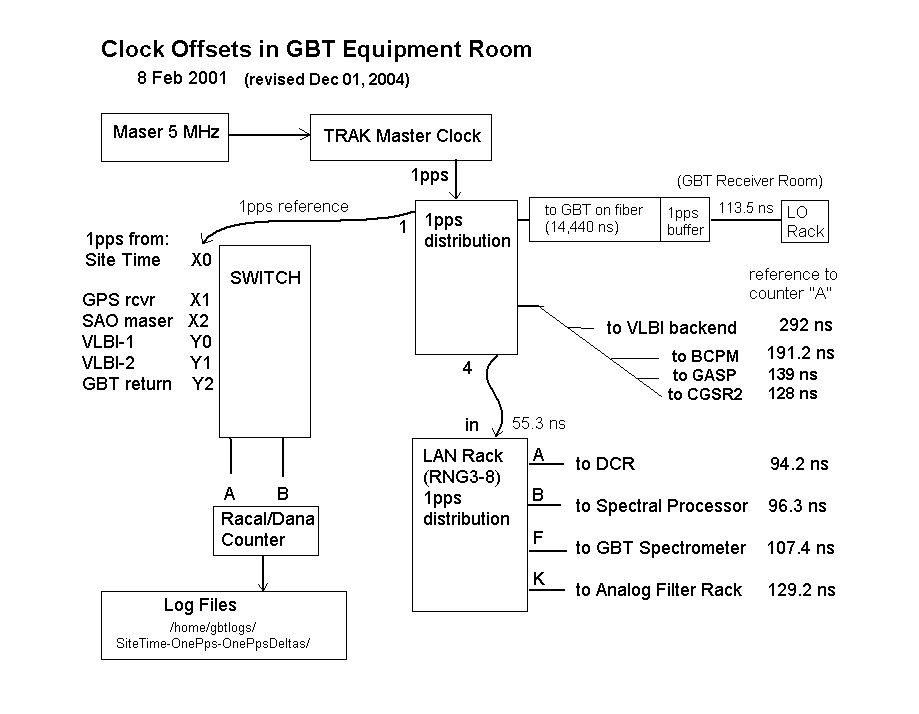
Diagram of old and new cabling
| Site 1Hz to: | delay |
|---|---|
| GUPPI | 121 ns |
| GASP | 139 ns |
| Spigot | 107.4 ns |
| SpectralProc | 96.3 ns |
| BCPM (now defunct) | 191.2 ns |
| CGSR2 (now defunct) | 128 ns |
The delay to GASP is 139nS; to CGSR2 128nS.  The same procedure was used as
described in the web page, except the Racal/Dana counter in the Timing Rack
was used instead of the Fluke 6681 Timer/Counter.  That should be fine,
but it has 1ns resolution.  I measured to the end of the NRAO 1pps cables;
there are of course delays from these points down into the bowels
of the backends.
SiteTime
As shown in the diagram, the master clock generates a 1pps signal, locked to a reference signal from the maser frequency standard. This 1pps, referred to as "SiteTime", is always kept within a few microseconds of UTC by comparison with time signals from a GPS receiver.
Logging delays
The SiteTime 1pps is compared with the GPS signal
and with other 1pps signals by selecting pairs of signals with the
switch and measuring the relative delay with the Racal/Dana counter,
which reads to 1 ns resolution. The switch and counter are computer
controlled, and automatically record the time delays between
SiteTime, GPS, and the other signals. These delays are recorded
about once every two minutes and stored in log files.
These log files in various formats may be found
in the
timing archives.
On 1/31/2001, delays of the 1PPS signal at various points in the Equipment Room were measured. A Fluke 6681 Timer/Counter was used to measure the delays. Two RG223 cables about 25 feet long, and matched to 0.3 nS were used to connect to the test points. The Fluke counter A input was connected to the cable normally connected to the A input of the Racal/Dana counter in the 1PPS Measurement system located in the Timing Center rack. The 1PPS Mux was locked to the X0 input, the Site Time 1PPS from the Trak clock. The Fluke counter B input was then connected to various points in the 1pps distribution system in the Equipment Room:
|
|