Research Projects

MUSTANG-- A 3mm Bolometer Array on the GBT

In collaboration with Mark Devlin's group at the University of Pennsylvania, a 64-pixel bolometer array has been constructed and is being commissioned on the GBT. First light was achieved in September of 2006. MUSTANG will be uniquely positioned for groundbreaking observations in a wide range of areas, from star-forming clouds, to novel high-resolution SZE measurements, to sensitive measurements of the highest-redshift galaxies.
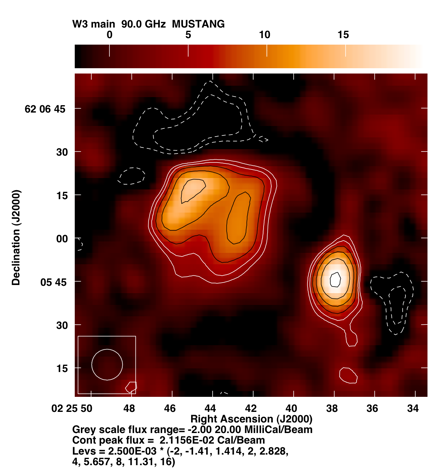
GBT+MUSTANG map of W3 (data from October 2006 engineering run; image courtesy of Bill Cotton)
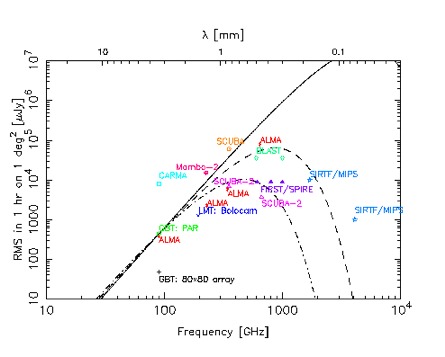
Expected Spectral Energy Distributions from galaxies at z=0, 5, and 10, compared to mapping sensitivities for a range of current and future instruments. Due to its large collecting area, a 64-pixel bolometer array on the GBT will be competitive with next-generation millimeter and submillimeter facilities.

Measuring Small Scale CMB Anisotropies

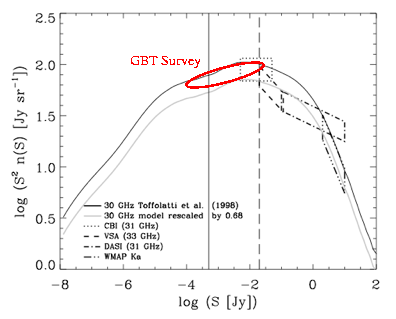
Measuring Small Scale Microwave Background Anisotropies using the Cosmic Background Imager (CBI) and GBT. These measurements are crucial to determining how and when present-day large-scale (cluster and supercluster) structures formed. A sensitive, broadband receiver in the 26-40 GHz (Ka-band) range has been commissioned on the GBT along with a dedicated digital backend (the Caltech Continuum Backend or CCB). We have collected over 100 hours of GBT data and four years of CBI data, with results forthcoming. In the near future, we will collect deeper GBT data to more precisely determine the faint point source foreground contribution to the high-ell excess seen by CBI. These measurements will also provide the first direct constraints on galaxy SEDs in the "desert" between about 15 GHz and 90 GHz, probing the relative contributions of thermal and nonthermal processes (and perhaps other mechanisms such as spinning dust) to radio emission from normal radio galaxies.
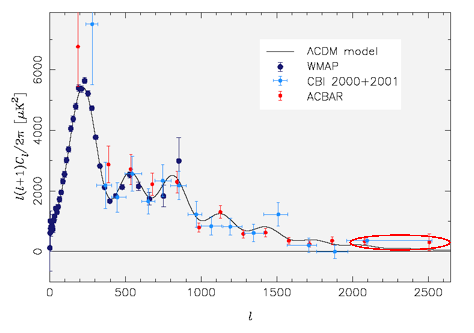
Selected CMB power spectrum measurements. To better understand the excess power seen at small angular scales (L > 2000) it is vital to better determine the properties of faint extragalactic radio sources. Power spectra are from Bennet et al. 2003; Readhead et al. 2004; and Kuo et al. 2004. Not shown are data from the OVRO/BIMA 30 GHz experiment (Dawson et al. 2006) which show consistent results on smaller angular scales.
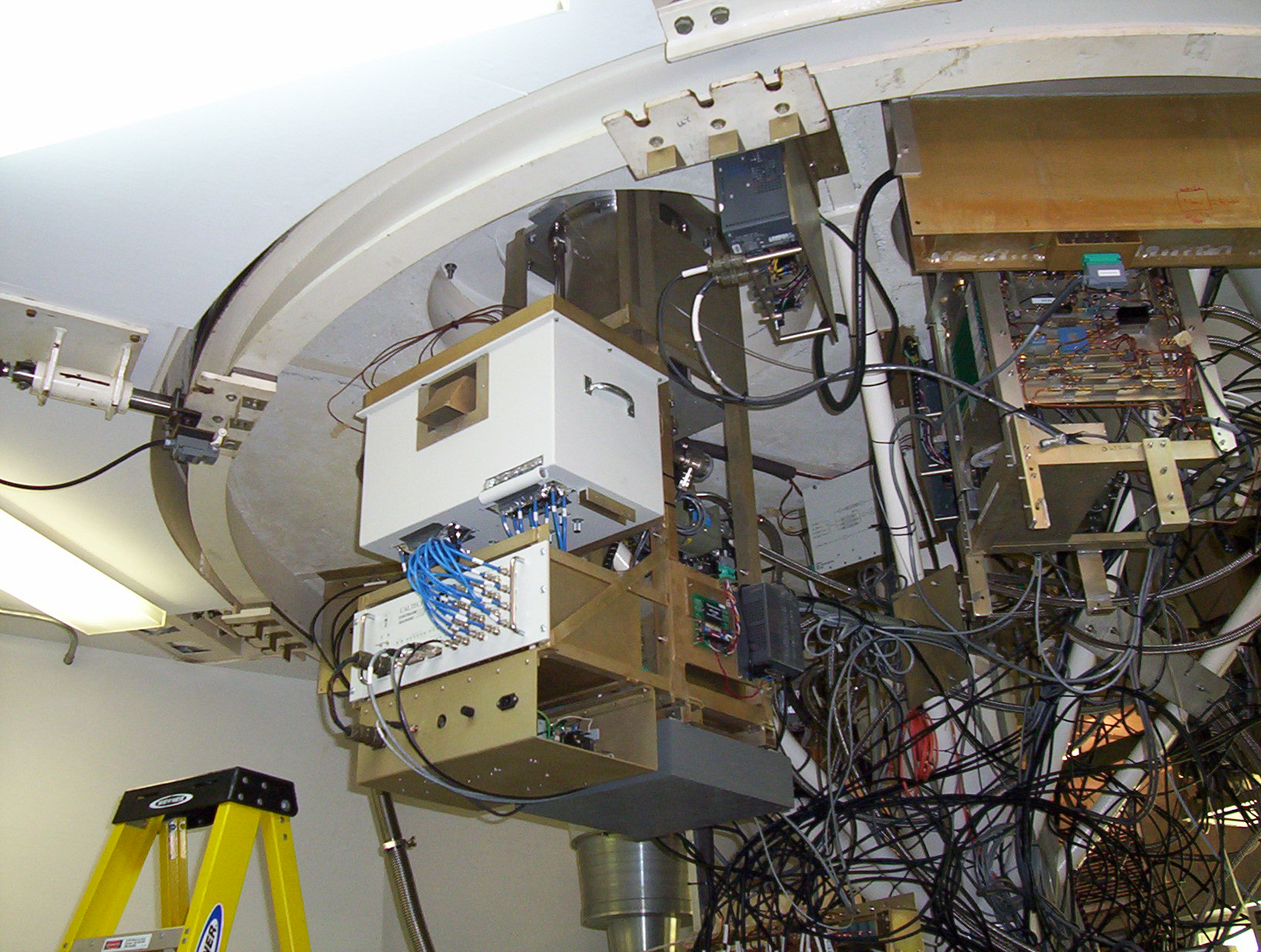
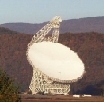
The Ka-band receiver and Caltech Continuum Backend mounted on the GBT, seen from inside the receiver room (December 2005)
Current constraints on, and models of, 30 GHz source counts, weighted by contribution to the residual variance to a map of the CMB. (Figure adapted from Cleary et al. 2005)

Microwave Polarization Foreground Measurements

The GBT's clear aperture and cutting-edge digital backends make it an excellent tool to investigate faint polarization signals at microwave frequencies, such as will be faced by the next generation of CMB polarization experiments. A host of measurements in the last decade have confirmed the existence of an anomalous, dust-correlated microwave foreground (so-called "spinning dust" or "foreground X"). This poorly-understood foreground could be a limiting factor for next-generation CMB polarization experiments. The polarized properties of extragalactic quasars and AGNs are also poorly characterized at high frequencies (15 GHz and above). Programs are underway with the GBT to study microwave polarization of spinning dust and of extragalactic radio sources.
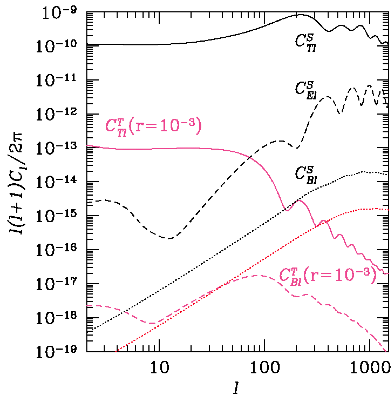
The expected cosmological polarization signals from primordial gravity waves and gravitational lensing of the polarized signal from the last scattering surface are orders of magnitude fainter than we have currently achieved and will require precise knowledge of astrophysical foregrounds.